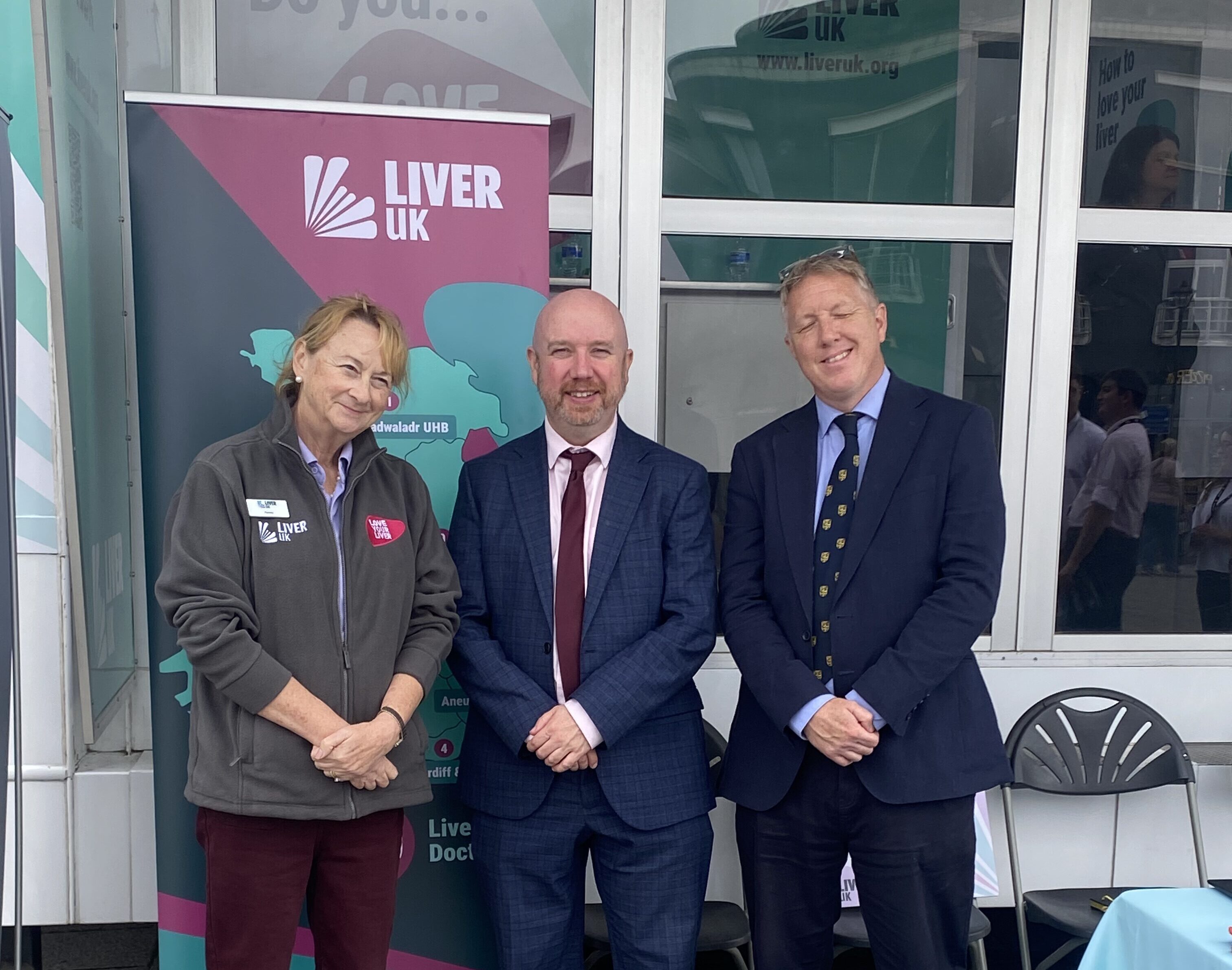
We brought our Love Your Liver Roadshow to Senedd Cymru on Tuesday 6th October, to highlight the urgent need for earlier detection and improved care in Wales. By attending with our Love Your Liver Unit, we were able to demonstrate our work to raise awareness of liver disease and its risk factors, but also to highlight the importance of improving outcomes for patients with liver disease in Wales.
The roadshow was open to Members of the Senedd. During the day, MSs had a non-invasive liver scan, which measures the stiffness of the liver, highlighting the effectiveness of these scans and their use for early detection. With an increased 96 Members of the Senedd (MS, there are now more opportunities to talk about what Wales can do to tackle the liver disease crisis. A new Senedd also provides a chance to influence the direction of health policy for the next five years, and we are determined that liver disease is part of that agenda.
Thanks to our political outreach and supporters writing to their MSs, 30 MSs from all political parties joined us on the day to discuss the need for Wales to have a dedicated national liver disease plan, so we can improve diagnosis and outcomes for patients with liver cancer and liver disease. The roadshow was sponsored by Natasha Asghar MS, Paul Davies MS, Joshua Kim MS, Jayne Bryant MS, Mike Hedges MS, Jason O’Connell MS and Anna Nicholl MS.
At the event, we spoke to the Minister for Health, Mabon ap Gwynfor MS, and the Deputy Minister for Public and Preventative Health, Nerys Evans MS, about their work to improve early diagnosis of liver disease and liver cancer in Wales. We were delighted to meet both Ministers and have the opportunity discuss the need for the Welsh Government to introduce a dedicated national liver disease plan.
Wales is facing a liver disease crisis. Liver disease deaths have more than doubled in the last 20 years. While 90% of liver disease is preventable and caused by alcohol misuse, obesity and viral hepatitis, the alarming reality is that three quarters of people are diagnosed with cirrhosis (the most severe form of liver disease) in hospital, when it’s too late for effective intervention or treatment. Liver disease is now the biggest cause of death among people aged 35 to 49 in Wales, and it falls hardest on our most deprived communities, where stigma and health inequalities are already entrenched.
Liver disease is a disease of inequality, falling hardest on disadvantaged communities, often diagnosed too late for people to receive effective treatment. The Seventh Senedd has a vital opportunity to change this trajectory. With a renewed national plan, sustained investment in prevention and early detection, and a fair, equal system of care for every patient, Wales can tackle the inequalities and give people the best possible chance of earlier diagnosis, effective treatment and better outcomes.
Our asks of the Welsh Government start with the national plan itself. It must be integrated into whole-system care and given the same status and visibility as other major disease areas. It should also confirm the future and resourcing of the All-Wales Abnormal Liver Blood Test Pathway, in place since 2022, so that it is consistently adopted and monitored across every health board. New research shows the pathway has increased chronic liver disease diagnosis by at least 20%, and Ministers should not leave that progress to chance.
CEO of Liver UK, Pamela Healy OBE, said:
“It is alarming that liver disease in Wales has risen by 400% across two generations, and that Wales has the highest mortality rate due to liver disease in the UK.
“Wales has a vital opportunity to tackle the liver disease crisis. This is why at Liver UK we are calling on the Welsh Government to act decisively through a whole-system approach, spanning prevention, early detection and treatment.
“This is why we call for the Seventh Senedd to commit to a new dedicated national plan for liver disease in Wales, integrated into whole-system care and given the same status and visibility as other major disease areas.”
Andrew Yeoman, Hepatology Clinical Lead for Wales, said:
“We are facing a liver disease crisis in Wales, with Wales having the highest mortality rate due to liver disease in the UK. Improving early diagnosis and care in Wales is a priority to reduce the number of preventable deaths. Wales has made huge steps in improving early detection of liver disease with the implementation of the All-Wales Abnormal Liver Blood Test Pathway. Wales can improve outcomes even more with the reestablishment of a national liver disease plan.”
Thank you to all our supporters in Wales who wrote to their MSs, inviting them to come along to the roadshow. We greatly appreciate your support.
Together we turn the tide on liver disease.