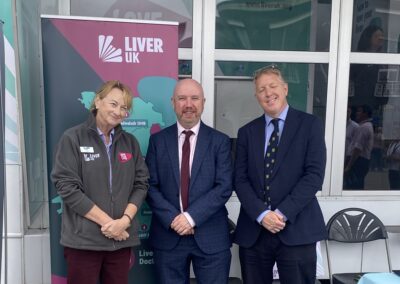
The British Liver Trust recently took part in an important roundtable discussion hosted by the All-Party Parliamentary Group (APPG) on the Less Survivable Cancers. The session highlighted the urgent need to address the stark inequalities in prognosis and improve early detection of the six cancers with the lowest survival rate – liver, lung, brain, oesophageal, pancreatic and stomach. These cancers account for over 69,000, and no less than 42% of the cancer deaths in the UK each year.
On Monday 17th March, Professor Stephen Ryder, Consultant Hepatologist at Nottingham University Hospital and a trustee of the British Liver Trust joined other health experts, policymakers and people with lived experience for the roundtable, where they spoke directly and openly with MPs. The discussion focussed on the key challenges in diagnosing less survivable cancers at an early stage and explored potential solutions to improve survival rates
Professor Steve Ryder delivered a clear and urgent message: early detection and surveillance of liver cancer is vital to saving lives. Liver cancer often develops silently in its early stages, delaying diagnosis until treatment options are limited. As a result, the five-year survival rate remains alarmingly low.
But according to Professor Ryder, early detection of underlying liver disease – especially in community settings – is one of our best tools to fight this trend and improve outcomes. This is because liver disease is the biggest risk factor for liver cancer. 80-90% of HCC, the leading form of primary liver cancer, patients have underlying cirrhosis. Hepointed to NHS pilot schemes, like Community Liver Health Checks, which are already helping to find liver disease in high-risk communities, using existing technology like FibroScans. He urged government and health leaders to preserve and scale up these NHS community-based screening programmes and invest in existing technology that can support early diagnosis, such as FibroScan technology and intelligent liver function tests, to help GPs test for liver damage in high-risk groups.
He also highlighted the issue of NHS data-sharing restrictions which slow down research and limit the effectiveness of diagnostic tools. Patients are often willing to share their data if it will improve their outcomes, but current regulations hinder this progress.
Pamela Healy, Chief Executive of the British Liver Trust, supported the findings of the roundtable: “Liver cancer is the fastest rising cause of cancer death in the UK. Every day, around 17 people are diagnosed with liver cancer. We have a real opportunity right now with a new national cancer plan in development to ensure the less survivable cancers, including liver cancer, get the attention they desperately need and more people are diagnosed at an earlier stage, when interventions are more effective.”
This roundtable was the first of two sessions in a focused mini-inquiry into how we can detect the UK’s least survivable cancers—like liver cancer—quicker and earlier, when treatment is more likely to be successful. To conclude the mini-inquiry, the APPG will publish a report which we plan to feed into.
Part of the British Liver Trust, Liver Cancer UK is dedicated to saving and improving the lives of people affected by liver cancer by raising awareness, providing support and influencing change.
Individuals are encouraged to take the free Liver Cancer Risk Checker, available at livercanceruk.org/liver-cancer-risk-checker. This simple tool helps individuals identify key risk factors and provides guidance on what to do next if they may be at risk.
If you or a loved one is affected by liver cancer, there are a wealth of information and support available to you at livercanceruk.org/support-for-you.