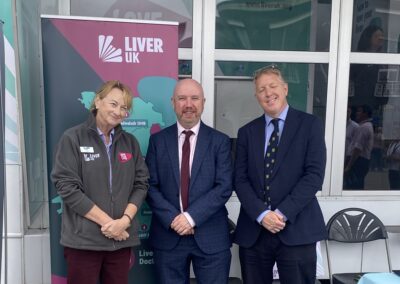
Less Survivable Cancers Awareness Day – calling for action to improve early diagnosis

January 11, 2023

Today (January 11th) is National Less Survivable Cancers Awareness Day, which aims to highlight the critical importance of early diagnosis in improving survival and quality of life for people diagnosed with less survivable cancers including liver cancer.

To mark the day, the Less Survivable Cancers Taskforce (LSCT) has released new data to highlight the critical importance of symptom awareness for early diagnosis of lung, liver, brain, oesophageal, pancreatic and stomach cancers.

Read more on our Liver Cancer UK website 

More news

Potential for hundreds more liver transplants after NICE recommends new life-saving liver procedure for NHS use

Potential for hundreds more liver transplants after NICE recommends new life-saving liver procedure for NHS use

The British Liver Trust welcomes the news that hundreds more liver transplants could be carried out after a new procedure that supplies a donor liver with oxygen before removal was approved by NICE for use in the NHS.   In-situ ...
New hope for people living with MASH as two treatments receive MHRA approval

New hope for people living with MASH as two treatments receive MHRA approval

People living with metabolic dysfunction-associated steatohepatitis (MASH) have received encouraging news, with the UK medicines regulator approving two treatments for the condition within the past month. The Medicines and Healthcare ...
New Lancet Commission Highlights the Vital Role of Primary Care in Tackling Liver Disease

New Lancet Commission Highlights the Vital Role of Primary Care in Tackling Liver Disease

A major new Lancet Gastroenterology & Hepatology Commission, published today, has shone a spotlight on the crucial role that primary care can play in preventing, detecting and managing liver disease. We were proud to contribute to ...
No results found.
Privacy Overview

This website uses cookies so that we can provide you with the best user experience possible. Cookie information is stored in your browser and performs functions such as recognising you when you return to our website and helping our team to understand which sections of the website you find most interesting and useful.