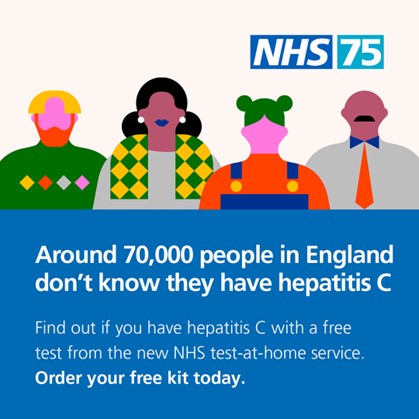
The NHS has launched a new scheme offering free confidential home tests for a potentially deadly liver condition.
What is hepatitis C?
Hepatitis C affects millions of people all over the world. But many do not know that they have it.
It is caused by a virus. People often have no symptoms when they first pick it up. But over years, or even decades, the virus can quietly damage your liver. Sadly, many people only find out that they have it when they suddenly become very unwell.
Without treatment the hepatitis C virus can cause cancer and cirrhosis. But if the virus is found early, it can be easily treated.
Free home testing
The World Health Organisation has set a target to end hepatitis C worldwide by 2030. To help reach the goal, the NHS is now offering a free test to those who might be at risk.
The test is available to people aged 18 or over who live in England.
You can order your testing kit here
You will need to prick your finger and collect a few drops of blood. These are sent to a laboratory for testing. The test kit will contain everything you need.
If the test shows that you have hepatitis C, you will be contacted by an NHS healthcare professional. They will talk with you about your results. And help you to get the right treatment.
Should I get a hepatitis C test?
If you think there is any chance you could have hepatitis C, then it is worth getting a test. Even if you have no symptoms and it is many years since you could have picked it up.
You should get a test if:
- You had an organ transplant, a blood transfusion, or received other blood products in the UK before 1992
- You have ever injected drugs
- You were born, or grew up, somewhere where hepatitis C is more common
- Your mother had hepatitis C when you were born
- You are a man living with HIV who has sex with men
- You have a close family member, friend, or sexual partner who has hepatitis C
- You have had a home-made tattoo or a tattoo done overseas
- If you go into prison you should be tested each time.
Treatment for hepatitis C
The treatment for hepatitis C is now very simple. If you have the virus, you will be asked to take tablets for 8 or 12 weeks. The medicine can cure more than 9 in 10 people with the virus. Most people have no side effects.
In the past, the treatment for hepatitis C was more difficult. People often had severe side effects. This type of treatment is not used in the UK anymore.
After you have been successfully treated, the damage to your liver will stop. Your liver has an amazing ability to repair itself. So, if the virus is stopped early enough, your liver can start to heal.
You can find lots more information about hepatitis C on our condition page here
Click here to find out about our campaign to make early diagnosis of liver disease routine