In July 2023, a new report from the NHS Race and Health Observatory highlighted an issue we have been thinking about for a while here at Children’s Liver Disease Foundation (CLDF) – identifying jaundice in newborn babies with different skin tones, and in particular the subjective nature of assessing jaundice using skin colour alone. The report is very timely and brings into focus some important issues, such as the need for a national bank of images showing medical conditions in darker skin, improved training for healthcare professionals and the use of more culturally appropriate terminology.
We also agree that genuine guidance on this issue is long overdue. Healthcare professionals, particularly midwives, health visitors and students, have repeatedly told us that they are concerned about detecting jaundice in Black, Asian and minority ethnic babies. So far, national guidance and good research has been lacking. The National Institute for Health and Care Excellence (NICE) recognises that jaundice can be more difficult to spot in darker skin, but they currently offer no recommendations for action.
There is some hope that things are changing. Research articles in recent years have started to focus on the use of transcutaneous bilirubin monitors as tools to assess jaundice. Such devices certainly add to the diagnostic options available, but we also need to consider what we can do for midwives and health visitors working in community settings without immediate access to these technologies.
So, what advice can we give to healthcare professionals? We can begin with a reminder that skin colour is not the only way to assess jaundice in a newborn. Other methods are documented in the literature and their merits are often discussed amongst healthcare professionals. Options include checking for yellowing on the palms of the hands or the soles of the feet, which could be easier to see in babies with darker skin tones. Checking for yellowing of the whites of the eyes (sclera) and of the gums are also used regularly. However, it is worth remembering that these methods still rely on visual inspection, so can be subjective.
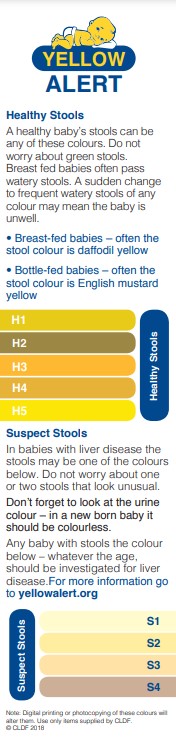
At CLDF, we promote the use of other indicators that may be particularly useful in Black, Asian and minority ethnic babies and in community settings. We recommend using stool and urine colour as more consistent indicators for neonatal jaundice and the detection of liver disease. Urine that is persistently yellow and which stains the nappy and stools that are persistently pale in colour may indicate that there is a problem. As with other techniques, stool and urine colour can be subjective, so we have developed a stool colour chart to help. This allows healthcare professionals to check the colour of a babies’ stool against a printed card, or against an electronic version via our app. Both resources are included in our Yellow Alert pack, which is available free to all healthcare professionals.
There is evidence to suggest that stool charts can have a positive impact on jaundice and liver disease recognition. They have been used in many countries for helping to diagnose Biliary Atresia, the most common childhood liver disease and have the added advantage of being cheap and portable. Midwives and health visitors have told us that they find it useful to have something they can take with them to appointments. The stool chart can also be given to new parents to encourage them to check stools and to seek further advice if needed.
So, where do we go from here? Without specific national guidance, and with the need to support healthcare professionals in detecting jaundice and liver disease in babies of all skin tones, a range of diagnostic methods remains the best option. However, we recommend that a stool chart should be a key part of the process and can easily be distributed and used more widely. By supplementing this with better training for healthcare professionals, we will have more chance of detecting and treating jaundice and liver disease in a timely manner.
Joanne Taylor
Information and Awareness Lead
Children’s Liver Disease Foundation
[email protected]
Stool charts are available free to all healthcare professionals as part of our Yellow Alert resources and can be viewed online or ordered in hard copy using our order form.