The National Institute for Health and Clinical Excellence (NICE) has today recommended elafibranor as a second-line treatment for primary biliary cholangitis (PBC). The British Liver Trust collated insight from patients and submitted evidence to NICE as part of the process. We’d also like to thank Lisa Woodcock, one of our supporters who lives with PBC, who gave evidence at the committee meeting.
This is the first new PBC drug approved by NICE for nearly a decade. And means there will be another option on the table for people with PBC living in England and Wales.
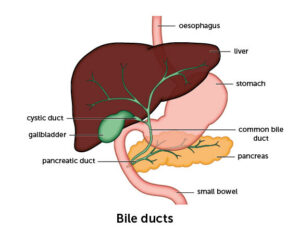
Primary biliary cholangitis is an autoimmune liver condition that affects the bile ducts. In PBC your immune system mistakenly attacks the bile ducts and damages them. The liver itself can then be damaged by bile leaking from the damaged ducts. PBC usually progresses very slowly, but over time damage can build up leading to cirrhosis and even liver failure.
The main treatment for PBC is ursodeoxycholic acid, also called UDCA or urso. It is an effective treatment for many people, but not for everyone. In some cases it doesn’t control PBC. And some people have side effects that mean they cannot take it. Up to now, the only other licensed medicine for PBC has been obeticholic acid (OCA). But like urso, it isn’t right for everyone. So there have been some people who don’t have a good option to treat their PBC.
This is where elafibranor comes in. It works differently to both urso and OCA by reducing the amount of bile acids produced and making the bile acids that are produced less damaging. Research has shown that taking it reduces blood levels of alkaline phosphatase (ALP) and bilirubin, key markers of liver damage in PBC.
Pamela Healy OBE, Chief Executive of the British Liver Trust said “The Trust have been involved throughout this consultation and we are delighted that NICE have recommended elafibranor as an additional treatment for PBC. We are especially pleased that the views of patients played an important part in the decision.”
The patient experts who took part in the review explained that the main benefit of elafibranor for them was reducing itching. Itching is a common symptom of PBC and for many patients it has a big impact on their quality of life, including making it harder to get enough sleep. OCA can make itching worse in some people, but elafibranor doesn’t have this side effect.
Lisa Woodcock, who lives with PBC and took part in the consultation, said “I was unresponsive to ursodeoxychloic acid and due to having severe itching (pruritis) as my main PBC symptom, obeticholic acid wasn’t an option due to it causing itch in most cases. There were no other licensed treatment options and I went on to have a liver transplant, therefore making me immunocompromised for the rest of my life. If there was another option at the time, this may not have needed to have happened. I am so pleased that elafibranor will become an option for people who find themselves in the position I was in, and I am sure it will help many avoid that last treatment option of transplant.”
Urso will still be the first medicine doctors try. But they will now be able to offer patients elafibranor instead of OCA as a second option. People can either have elafibranor in addition to urso, to make it more effective. Or doctors can prescribe it as a standalone treatment.
Dr Neil Halliday, consult at the Royal Free Hospital London, said “This is good news for people with PBC. Having another option means patients can get the best possible treatment for their PBC, hopefully slowing down the disease and minimising any symptoms.”
The way medicine approvals work in the UK means the NICE decision only covers England and Wales. The Northern Ireland Department of Health have an agreement with NICE where they review guidance to check it is suitable for Northern Ireland and can then adopt it. The Scottish Medicines Consortium has scheduled elafabrinor for assessment and expects to publish advice in the second quarter of 2025. We hope that it will be approved and available to patients across the UK as soon as possible.