
What is biliary atresia?

Biliary atresia is a rare disease of the liver and bile ducts. It presents very early in life and requires urgent treatment.
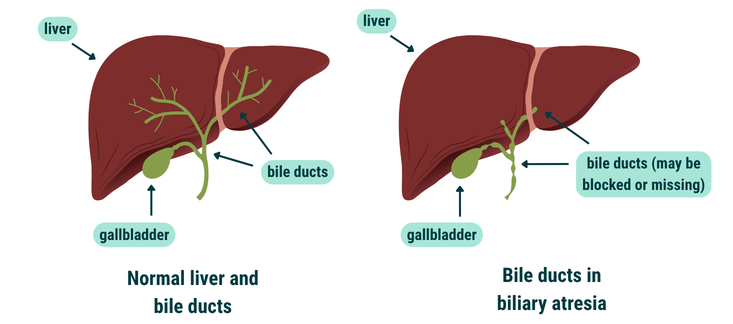
In newborns with biliary atresia, bile ducts are missing, incomplete, blocked or damaged. This stops the flow of bile from the liver to the gallbladder and small intestine. Bile backs up and gets trapped inside the liver.
The information on this page is for:
- Parents of babies and children with biliary atresia or suspected biliary atresia.
- Young people with biliary atresia.
- Family, friends, carers, and healthcare professionals.
On this page:
What is biliary atresia?
Biliary atresia is a rare disease of the liver and bile ducts. It is a serious condition that a baby is born with. It therefore presents very early in life and requires urgent treatment.
Bile ducts are tiny tubes that connect different organs, including the liver and gallbladder. They are part of the digestive system. Bile ducts carry bile from the liver to the gallbladder and small intestine.
In newborns with biliary atresia, are missing, incomplete, blocked or damaged. This stops the flow of bile from the liver to the gallbladder and small intestine. Bile backs up and gets trapped inside the liver. This is known as cholestasis. It may cause serious damage to the liver as cells die and are replaced with scar tissue (fibrosis).
Bile is a green/yellow liquid that is made in the liver and stored in the gallbladder. It helps the body:
- digest food by breaking down fats
- absorb vitamins A, D, E & K
- get rid of waste products such as bilirubin and leftover cholesterol
Babies with biliary atresia may also be born with other problems affecting the heart, blood vessels, spleen, intestines and kidneys. This is called biliary atresia splenic malformation syndrome (BASM).
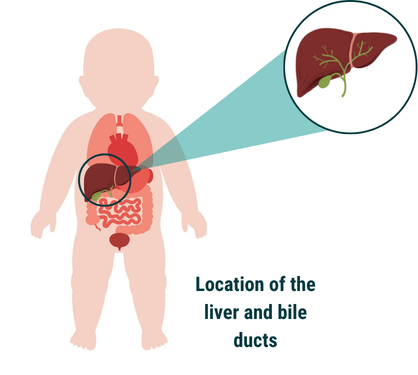
How common is it?
Biliary atresia happens in around 1 in 10,000 to 1 in 20,000 births in the UK.
Types of biliary atresia
There are 3 different types of biliary atresia. The type is based on the location of the blockage and the amount of damage to the bile ducts. In all types, bile ducts inside the liver are damaged.
Type I
This type happens in around 5-10% of newborns with biliary atresia. In this type, the blockage happens in the common bile duct, but some of the bile ducts near the liver may stay open. Bile is usually found in the gallbladder.
Type II
This type is rarer and happens in around 1-2% of newborns with biliary atresia. In this type, the blockage happens in the common hepatic duct, but some of the bile ducts near the liver may stay open.
Type III
This is the most common type of biliary atresia and happens in more than 90% of newborns with the condition. You may also hear it called extrahepatic biliary atresia. In type III, all the bile ducts outside the liver are missing, blocked or damaged. This causes a total and permanent blockage of bile flow.
There are other sub-types of biliary atresia. This includes biliary atresia splenic malformation syndrome (BASM).
The treatment for all types is the same, but the results are slightly better if your baby has type I or type II biliary atresia.
Support
How Liver UK can help
A diagnosis of liver disease can be worrying, and you may have a lot of questions.
We're here for you and for your family and friends. Whether you have questions or just need someone to listen, we can help.

Your feedback
This content was last reviewed: July 2026
Our expert reviewers:
We would like to thank everyone who helped with creating and reviewing this page. Including Professor Mark Davenport, Consultant Paediatric Surgeon, King’s College Hospital and Professor Deirdre Kelly, Professor of Paediatric Hepatology. And all our patient reviewers.
Find out how we make our patient information.
Everyone’s experience of liver disease will be different. Always talk to your specialist medical team for personal advice.

More from Liver UK

Check your risk
Find out more

Support us
Find out more

Keep up to date
Find out more