
Autoimmune liver disease
in children

Autoimmune diseases are conditions in which the immune system mistakenly attacks and damages the body’s healthy cells. There are 3 autoimmune liver diseases that can happen in children.
The information on this page is for:
- Parents of children with autoimmune liver disease or suspected autoimmune liver disease.
- Young people with autoimmune liver disease or suspected autoimmune liver disease.
- Family, friends, carers, and healthcare professionals.
Quick Summary
- Autoimmune diseases are conditions in which the immune system mistakenly attacks and damages the body’s healthy cells.
- In autoimmune liver disease, the immune system attacks healthy liver cells, bile duct cells or both.
- There are 3 autoimmune liver diseases that can happen in children.
- Autoimmune hepatitis is split into type 1 and type 2.
- Blood tests, scans and biopsies help with the diagnosis.
- Treatment involves using medicines to make the immune system less active.
- The length of treatment will vary from child to child. Treatment is likely to last for several years, and often longer (sometimes for life).
- Relapses can happen suddenly, at any point. But they are most likely to happen during the first 2 years of treatment and during puberty.
- Long-term monitoring is important due to the risk of relapse.
- In a small number of children, damage to the liver becomes worse over time.
Find out more about autoimmune liver disease using the links below.
What are autoimmune diseases?
Autoimmune diseases are conditions in which the immune system mistakenly attacks and damages the body’s healthy cells.
The immune system usually defends us against bacteria and viruses that make us ill. It does this by making proteins called antibodies.
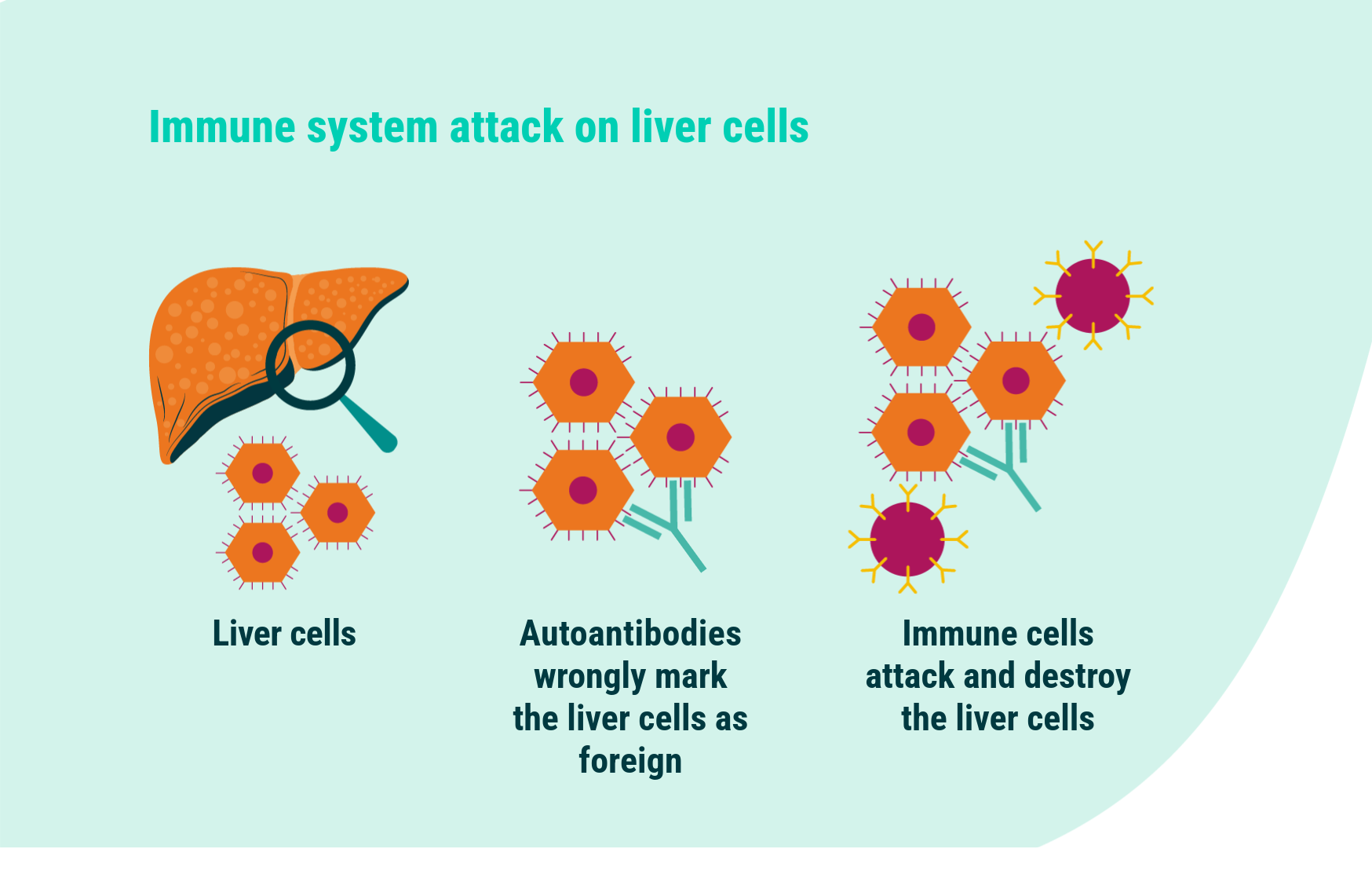
In autoimmune conditions, the immune system starts to make antibodies that stick to healthy cells. They are called autoantibodies. Each different antibody will only stick to one very specific marker. So autoantibodies will stick to one type of cell in the body. When this happens, the immune system will treat those cells as dangerous and attack them. This causes damage to cells and organs.
The body creates autoantibodies by mistake. It is not clear why the immune system acts in this way. There may be some factors that work together to trigger the reaction, including:
- a problem with the immune system
- genetics – it can run in families due to inherited genes
- causes outside the body, such as getting a virus or taking certain medicines
But some autoantibodies have no direct cause or trigger. In autoimmune liver disease, the immune system mistakenly attacks and damages healthy cells. This may be liver cells (hepatocytes), bile duct cells (cholangiocytes) or both. This leads to inflammation in the liver.
Autoimmune liver diseases are NOT caused by alcohol or other toxins.
What are the different autoimmune liver diseases in children?
There are three autoimmune liver diseases that can happen in children:
- autoimmune hepatitis (AIH)
- autoimmune sclerosing cholangitis (ASC)
- autoimmune hepatitis after liver transplantation for a non autoimmune liver disease. This is also known as de novo autoimmune hepatitis.
We know that autoimmune liver disease is rare in children. But we don’t know the exact numbers affected. But we do know that:
- autoimmune hepatitis happens in less than 1 in every 100,000 children each year
- autoimmune hepatitis is more common in girls than in boys
Find out more

Download booklet
Useful words
Antibody – a protein produced by the immune system to defend against a specific disease
Autoantibodies – antibodies that attack someone’s own body
Autoimmune – A type of disease where the immune system attacks and damages part of someone’s own body
Cholangitis – Inflammation of the bile ducts
Immune system – the body’s defences against illness and infection
Hepatitis – Inflammation of the liver
Support
How Liver UK can help
A diagnosis of liver disease can be worrying, and you may have a lot of questions.
We're here for you and for your family and friends. Whether you have questions or just need someone to listen, we can help.

Your feedback
This content was last reviewed: June 2025
Our expert reviewers:
We would like to thank everyone who helped with creating and reviewing this page. This information has been produced with input from the three specialist paediatric liver centres in the UK. And with parents and families.
Find out how we make our patient information.
Everyone’s experience of liver disease will be different. Always talk to your specialist medical team for personal advice.

More from Liver UK

Check your risk
Find out more

Support us
Find out more
Keep up to date
Find out more