
What causes PFIC?

Progressive familial intrahepatic cholestasis (PFIC) is the name given to a group of conditions in which a digestive fluid, called bile, is not released properly from the liver into the gut (gastrointestinal tract).
The information on this page is for:
- Parents of children with PFIC or suspected PFIC.
- Young people with PFIC.
- Family, friends, carers, and healthcare professionals.
On this page:
What causes PFIC?
PFIC is a genetic condition. This means it is caused by changes (mutations) in a person’s genes.
Genes are sections of DNA that contain the instructions for making proteins. These proteins are the building blocks for everything in the body. They control how it grows and works.
Many of us will have some changes in our genes. Usually, these do not have any impact. Sometimes, however, these changes can cause diseases and other problems.
There are different types of PFIC. Each type is caused by changes in a different gene.
What are the chances of a child inheriting PFIC from their parents?
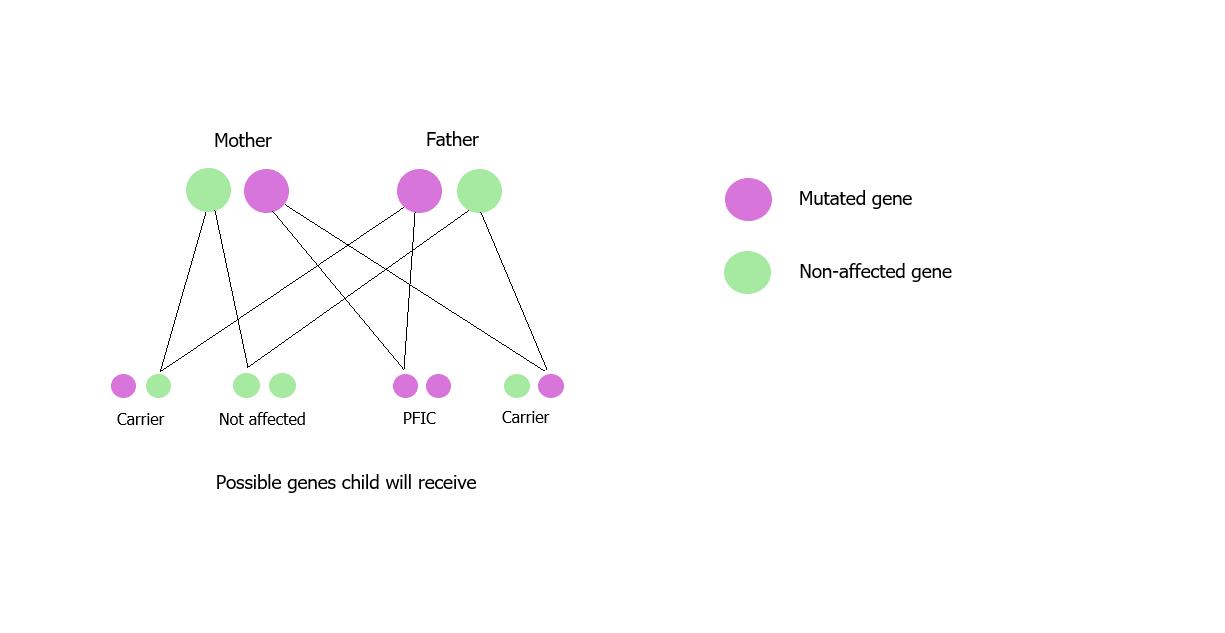
PFIC usually only happens when both parents are carriers of the change (mutation) that causes PFIC.
A carrier of the condition has one copy of the mutated gene. They do not have the disease themselves and will probably not know they are at risk of passing on the mutated gene. This is why conditions like PFIC can come ‘out of the blue’ for families. It is only when a child receives two mutated genes (one from each parent) that they develop the disease.
If both parents are carriers, the chance of a child receiving a mutated gene from both parents (and therefore having PFIC) is one in four (25%). If the child only receives one copy of the mutated gene, they won’t have PFIC, but will be a carrier. This pattern is called “autosomal recessive”.
What are the different types of PFIC?
There are three main types of PFIC:
- F1C1 deficiency (previously known as PFIC1)
- BSEP deficiency (previously known as PFIC2)
- MDR3 deficiency (previously known as PFIC3)
Other types of PFIC are also being discovered as we learn more about the gene mutations.
Each type of PFIC is caused by a change (mutation) in a different gene. These changes can be more or less severe in different children. This leads to differences in the disease, its severity, symptoms and the treatments available.
F1C1 deficiency
This type is caused by changes (mutations) in the ATP8B1 gene, which leads to a shortage of the FIC1 protein.
F1C1 deficiency has been divided into:
- PFIC
- benign recurrent intrahepatic cholestasis (BRIC)
PFIC and BRIC are the same condition, but they have different levels of severity.
BSEP deficiency
BSEP deficiency is the most common type of PFIC. It is caused by changes (mutations) in the ABCB11 gene. This gene tells the body to make a protein called the bile salt export pump (BSEP). Changes in this gene cause bile acids to build up in liver cells. This leads to liver damage.
MDR3 deficiency
MDR3 deficiency is caused by changes (mutations) in the ABCB4 gene. This gene tells the body to make a protein which moves fats across the outer layer (membrane) of cells. When there is a change in this gene, bile acids can build up outside the liver cells. This can cause damage to the bile ducts and liver.
Other types of PFIC
Doctors have identified other types of PFIC, but they are very rare:
- TJP2 deficiency
- FXR deficiency
- MY05B deficiency
- USP53 deficiency
- FXR deficiency
Researchers think they will be able to identify more genetic causes of PFIC as testing gets better.
How we can help
Support for you
We’re here to support anyone affected by liver disease, as well as their families and loved ones.

Your feedback
This content was last reviewed: March 2024
Our expert reviewers:
We would like to thank everyone who helped with creating and reviewing this page. This information has been produced with input from the three specialist paediatric liver centres in the UK. And with parents and families.
Find out how we make our patient information.
Everyone’s experience of liver disease will be different. Always talk to your specialist medical team for personal advice.
More from Liver UK

Check your risk
Find out more

Support us
Find out more
Keep up to date
Find out more