
What are the symptoms of Wilson’s disease?
There is a wide range of possible symptoms of Wilson’s disease. These include liver, nervous system, and mental health symptoms.
People with Wilson’s disease are born with it. But symptoms often appear slowly and may be confused with other health issues.
How bad the symptoms become varies a lot from person to person. Some people will only ever have mild symptoms. Others will become very seriously ill.
Young children are more likely to have liver symptoms first. Adults and older teenagers might notice liver, nerve, or mental health symptoms first.
Different people will have different symptoms in different combinations. The lists on this page give some examples of symptoms.
You cannot diagnose or rule out Wilson’s disease based on symptoms. If you or your child might have Wilson’s disease, then testing and diagnosis are essential.
The information on this page is for:
- Adults and children with Wilson’s disease or suspected Wilson’s disease
- Parents of children with Wilson’s disease or suspected Wilson’s disease
- Family, friends, carers, and healthcare professionals
On this page:
Liver (hepatic) symptoms of Wilson’s disease
Wilson’s disease usually starts with copper building up in the liver. In young children with Wilson’s disease, the most common symptoms are liver symptoms. Older children and adults might also get liver symptoms first.
You might hear these called hepatology or hepatic symptoms
Liver symptoms of Wilson’s disease include:
- tummy pain
- a yellow colour to the eyes and skin (jaundice)
- fluid build-up in the tummy (ascites)
- bruising or bleeding more than is normal
Neurological (brain and nervous system) symptoms of Wilson’s disease
Over time, copper also starts to build up in the brain. This can cause symptoms that affect your nervous system. You might hear these called neurological symptoms.
Some people will notice these symptoms before any others. This usually happens in young adults at around 20 to 30 years old.
Nervous system symptoms can include:
- shaking, often in the hands (tremor)
- slurred or unclear speech (dysarthria)
- dribbling
- slow or jerky movements
- problems with memory or concentration
- changes to handwriting, often it can become small and cramped
Mental health (psychiatric) symptoms of Wilson’s disease
Copper build-up in the brain can also lead to mental health issues, like mood swings and changes in behaviour. You might hear these called psychiatric symptoms.
In older children and adults, these symptoms can start before any others. When this happens, they are often confused for other conditions leading to misdiagnosis.
Mental health symptoms can include:
- personality and behaviour changes
- ongoing low mood (depression)
- constant worry or nervousness (anxiety)
Learning and behaviour changes in children and teenagers with Wilson’s disease.
Wilson’s disease can mean that children start to do less well at school. It can also affect their personality. Children might start to behave badly or in inappropriate or impulsive ways.
Wilson’s disease symptoms often start in the teenage years. If the child has not been diagnosed with Wilson’s disease, then these symptoms might just be put down to puberty. In some cases, doctors misdiagnose children with behaviour problems.
Symptoms of Wilson’s disease in other parts of the body
Kayser-Fleischer (KF) rings in the eyes
Copper can build up in the eyes. This can cause a copper-coloured crescent around the coloured part of the eye. Over time this can become a copper-coloured ring.
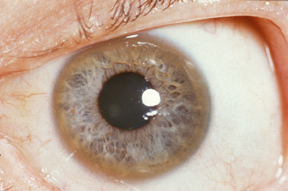
This build-up of copper in the eye is called a Kayser-Fleischer (KF) ring.
KF rings are not harmful and do not affect vision. But they do indicate copper overload. Wilson’s disease is the most common cause of KF rings. So they can help to confirm the diagnosis.
An eye specialist, known as an ophthalmologist, can check for them. They will use a type of eye test called a slit lamp examination.
Opticians do not look for KF rings as part of a normal eye test. You will usually need to see a specialist.
Most adults with Wilson’s disease have KF rings. But it is less common in children and in people who only have liver symptoms.
With treatment, KF rings can fade.
Coombs-negative haemolytic anaemia
People with Wilson’s disease can get a type of anaemia called Coombs negative haemolytic anaemia.
Anaemia is when there aren’t enough healthy red blood cells to transport oxygen around the body. There are many types of anaemia. The term “Coombs-negative haemolytic anaemia” describes findings from a blood test.
- Coombs negative = The Coombs test looks for antibodies attacking red blood cells. Coombs negative means there are no antibodies. So it is not an autoimmune condition.
- Haemolytic or haemolysis = This means red blood cells are made but break down too quickly. So there are not enough to carry blood around the body properly.
Support
How Liver UK can help
A diagnosis of liver disease can be worrying, and you may have a lot of questions.
We're here for you and for your family and friends. Whether you have questions or just need someone to listen, we can help.

Everyone’s experience of Wilson’s disease will be different. Always talk to your specialist medical team for personal advice.
Our information aims to be clear, up-to-date, and useful. We work with people living with liver disease and clinicians to make our information.
The main source for this information is: EASL-ERN clinical practice guidelines on Wilson’s disease, 2025
This content was last reviewed: December 2025
We would like to thank all the patients and families who helped to create this information. Thank you to our clinical reviewer, Dr William Griffiths, consultant hepatologist, Cambridge University Hospitals NHS foundation trust.
Find out how we make our patient information.
Your feedback
More from Liver UK

Check your risk
Find out more

Support us
Find out more
Keep up to date
Find out more