
How is Wilson’s disease passed down or inherited?
Wilson’s disease is a genetic condition passed down in families. You only get the condition if you inherit a changed copy of the Wilson’s gene from both your parents.
If someone has Wilson’s disease, their close family members should also have tests for it.
The information on this page is for:
- Adults and children with Wilson’s disease or suspected Wilson’s disease
- Parents of children with Wilson’s disease or suspected Wilson’s disease
- Family, friends, carers, and healthcare professionals
On this page:
How does a gene cause Wilson’s disease?
Wilson’s disease happens when a gene change stops the liver removing excess copper.
The gene that causes Wilson’s disease is called ATP7B.
This gene tells your liver how to make a protein that helps the body remove copper.
People with Wilson’s disease have a changed version of this gene. This is like having a spelling mistake in the instructions for making the protein. It means the liver cannot make the protein properly.
The changed version of the gene is called a variant version or variant gene. You might also hear it called a gene fault, or gene mutation.
We know about more than 2,700 different variants of the Wilson’s gene. Researchers know that at least 800 of these cause the condition. But there are likely more that we have not found yet.
Some variants are more common in certain parts of the world.
How is Wilson’s disease inherited?
Wilson’s disease only happens if you inherit two variant versions of the Wilson’s gene.
We all have 2 copies of every gene. We get one from each of our biological parents.
Most people inherit 2 normal copies of the Wilson’s gene. So they will not develop Wilson’s disease.
Wilson’s disease only happens when someone inherits 2 changed or variant copies of the Wilson’s gene. You might hear this type of inherited condition called an autosomal recessive condition.
Carriers
If someone inherits just one variant copy of the Wilson’s gene, their liver can use their other, working copy. They will not have Wilson’s disease. But they could pass on the variant gene. This is called being a carrier.
About 1 in 40 people are carriers of Wilson’s disease.
You will not get Wilson’s disease if:
- You have one working and one variant Wilson’s gene (you are a carrier)
- You have 2 working copies of the Wilson’s gene.
Not everyone with the genes for Wilson’s disease will develop the condition
It is thought that only about 1 in 4 people who have the genes for Wilson’s disease will develop the condition. We do not yet fully understand why some people with the genes get Wilson’s disease and others do not.
Doctors sometimes talk about “gene penetrance” this is difference between the number of people with the genes for a condition and the how many of them actually have the condition.
What are the chances my children will get Wilson’s disease?
If you have Wilson’s disease, you will pass on the gene for it to your children. But they will only get the condition if they inherit a variant of the Wilson’s gene from both parents. And even if they have two variant versions, they might not get the condition.
Overall, if you have Wilson’s disease, the chance of your child also getting it is less than 1 in 100.
The risk is higher if you and your partner are blood relatives (like cousins). This is because you are more likely to have similar genes.
Which genes we pass on is random. We have no control over which genes we get from our parents. Or over which copy of each gene we pass on to our children.
If you are thinking about starting a family, talk to your Wilson’s team and ask for a referral to a genetic counsellor. They will be able to talk to you about the chances of passing on the condition. They can also tell you about tests and help you to decide if these would be a good option for you.
Examples: How children inherit Wilson’s disease
If I have Wilson’s disease, will my children get it?
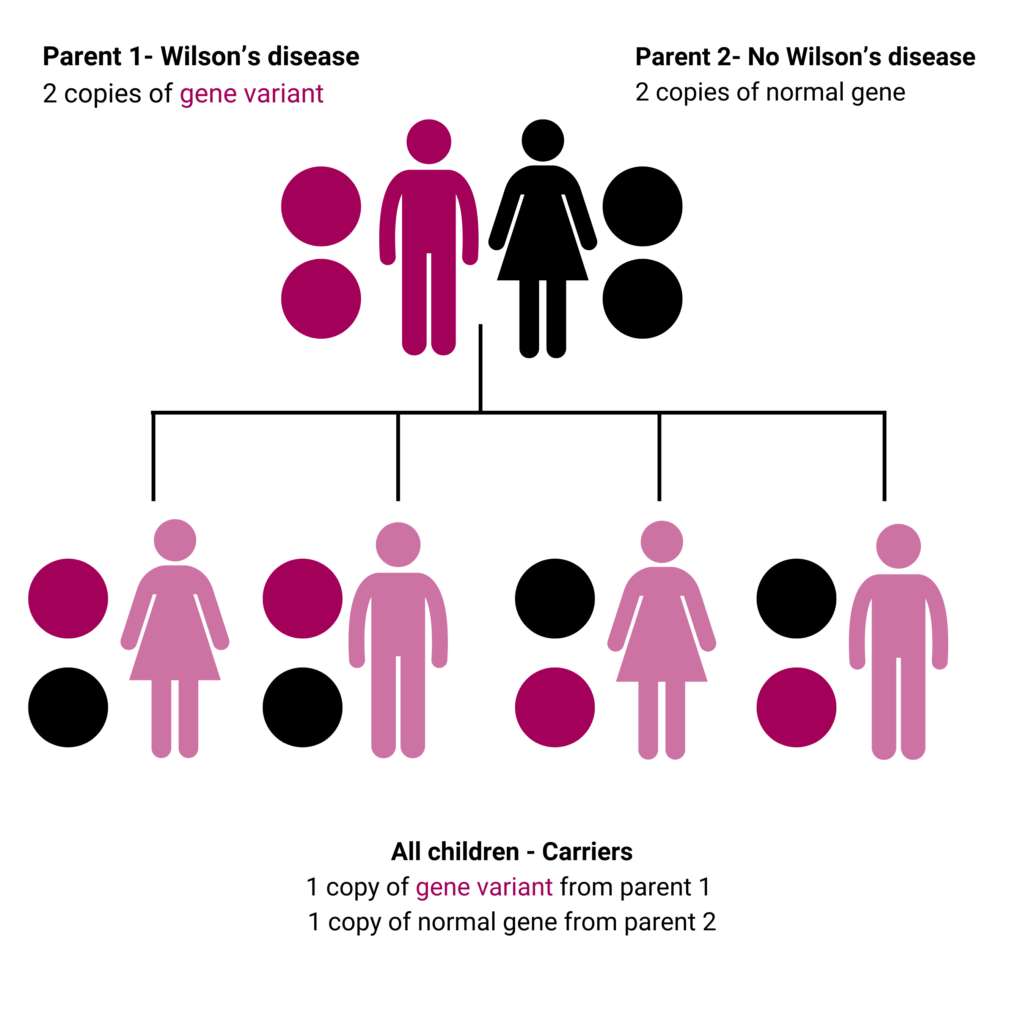
If I have Wilson's disease and my partner does not, will our children get it?
If you have Wilson’s disease and your partner does not and is not a carrier:
All your children will get a variant gene from you and a working gene from their other parent.
This means that:
- None will have Wilson’s disease.
- All will be carriers.
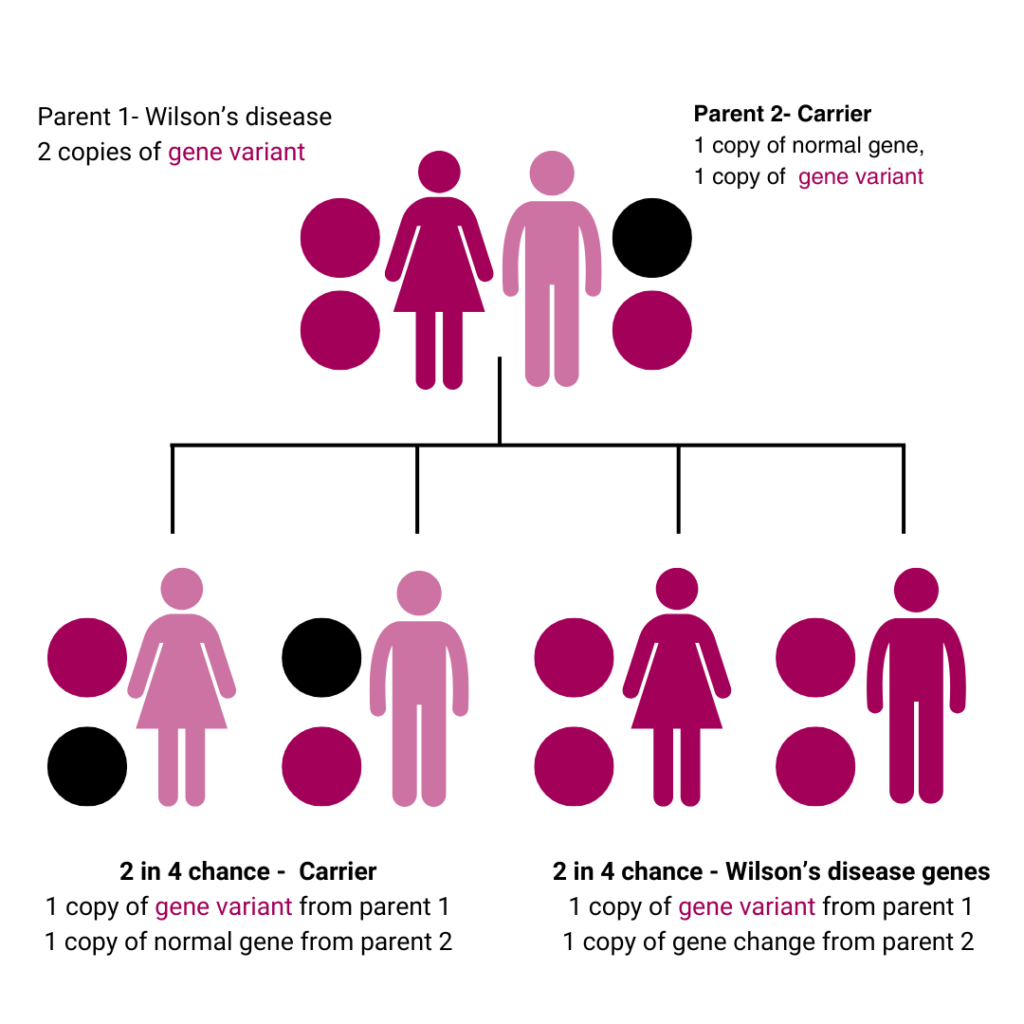
If I have Wilson’s disease and my partner is a carrier will our children get it?
All of your children will get a variant version of the Wilson’s gene from you.
Each children has a 50/50 chance of getting a variant version or a working version of the gene from their other parent.
This means each child has a:
- 1 in 2 chance of getting a variant version from their other parent and having the genes for Wilson’s disease.
- 1 in 2 chance of getting a normal version from their other parent and being a carrier.
But having the genes for Wilson’s disease does not always mean someone will get the condition.
If I have Wilson’s disease and so does my partner, will our children get it?
All of your children will inherit a variant version of the gene from you and from their other parent.
This means that all of your children will inherit the genes for Wilson’s disease
But having the genes for Wilson’s disease does not always mean someone will get the condition.
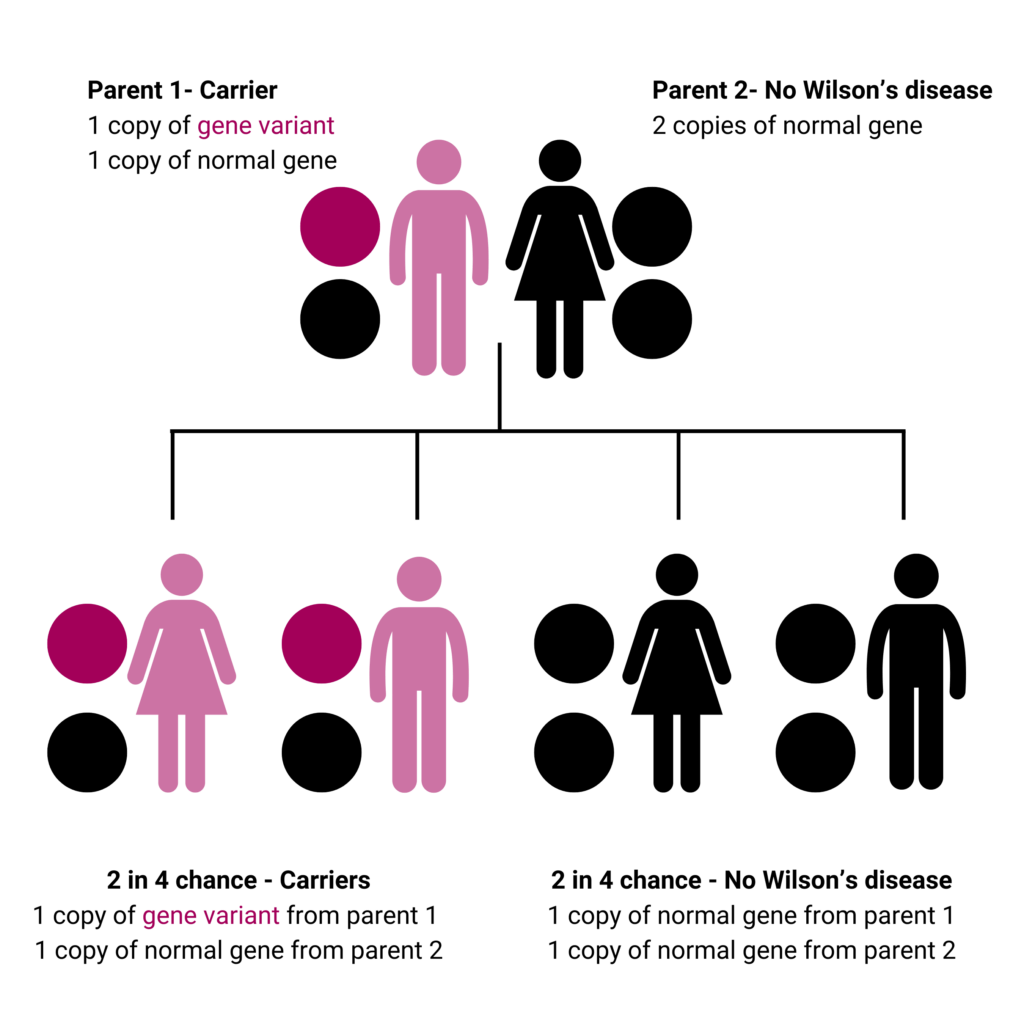
If I am a carrier for Wilson’s disease will my children get it?
If I am a carrier for Wilson’s disease but my partner is not will my children get it?
All your children will get a normal version of the gene from their other parent.
None of your children will have Wilson’s disease.
Each child has a 1 in 2 chance of getting the variant version or a normal version of the gene from you.
This means each child has a:
- 1 in 2 chance of getting 1 variant gene from you and being a carrier
- 1 in 2 chance of getting a working gene from you. This means they will not have the condition and will not be a carrier.
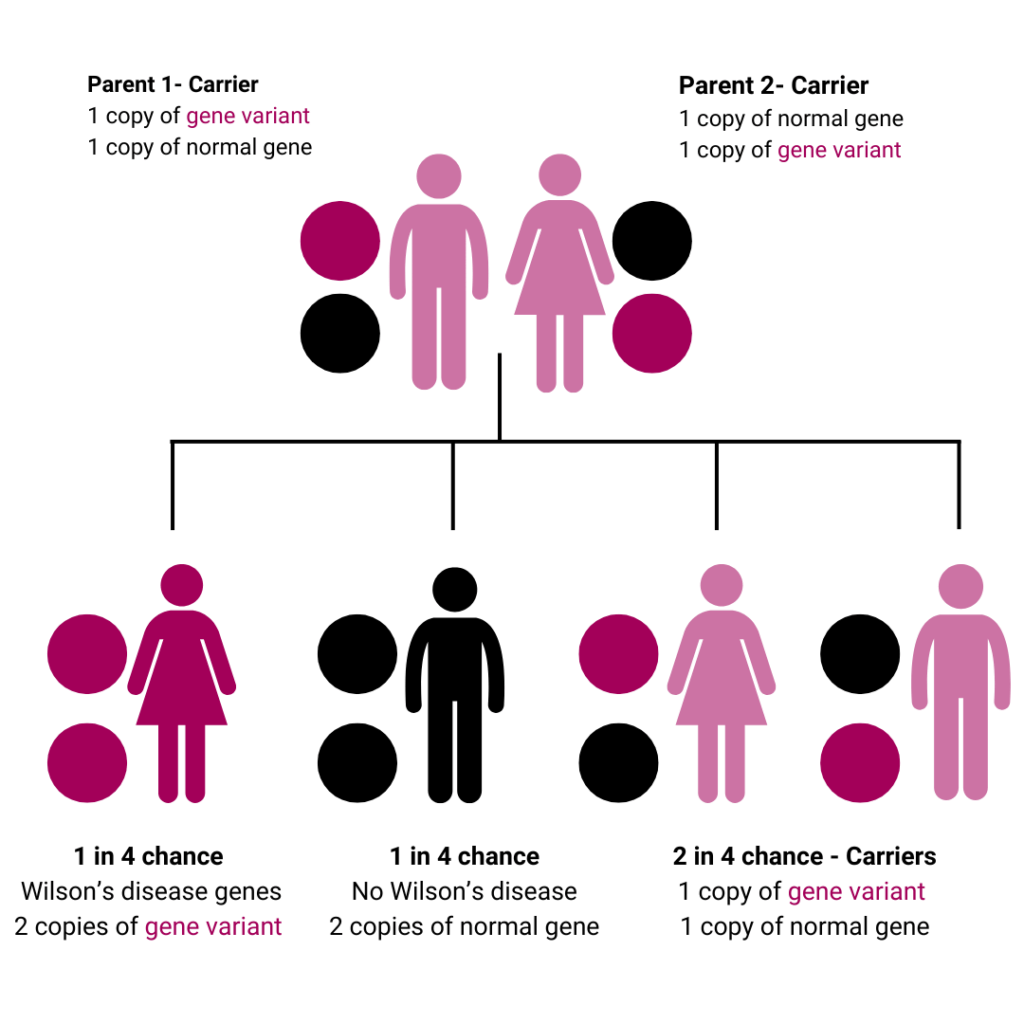
If I am a carrier for Wilson’s disease and so is my partner, will our children get it?
Each of your children will have a 1 in 2 chance of getting a variant gene from you and a 1 in 2 chance of getting a variant gene from their other parent.
This means each child has a:
- 1 in 4 chance of getting 2 variant versions and having the Wilson’s disease genes.
- 1 in 4 chance of getting 2 working versions. This means they will not have Wilson’s disease and will not be able to pass it on.
- 2 in 4 chance of getting 1 normal gene and one variant version and being a carrier.
Who else should have tests for Wilson’s disease?
If someone has Wilson’s disease, it is important for close family members to have tests too.
Early detection of Wilson’s disease allows treatment to begin before serious damage occurs to the liver or brain. This may mean starting treatment before there are any symptoms of the condition.
Close family members who should have tests are:
- brothers and sisters
- children
Sometimes testing is also offered to cousins.
Find out more about testing for family members.
Find out more about genetic and inherited liver conditions
Useful words – genetic terms explained
ATP7B – The gene that can cause Wilson’s disease
Autosomal recessive – how some genetic conditions pass from one generation to the next. You need to inherit a variant gene from both parents to get the condition.
Carrier – Someone who has one variant copy and one working copy of the Wilson’s gene. A carrier doesn’t have the condition, but there’s a chance they could pass it on to their children.
Gene – A part of your DNA that gives your body instructions. You have two copies of each gene, one from each parent.
Gene penetrance – The difference between how many people have the genes for a condition and how many actually get the condition.
Genetic testing – A test that looks for specific changes in a gene or genes.
Variant gene – A gene that has changed in some way. This might also be called a changed, mutant, or faulty gene.
Support
How Liver UK can help
A diagnosis of liver disease can be worrying, and you may have a lot of questions.
We're here for you and for your family and friends. Whether you have questions or just need someone to listen, we can help.

Everyone’s experience of Wilson’s disease will be different. Always talk to your specialist medical team for personal advice.
Our information aims to be clear, up-to-date, and useful. We work with people living with liver disease and clinicians to make our information.
The main source for this information is: EASL-ERN clinical practice guidelines on Wilson’s disease, 2025
This content was last reviewed: December 2025
We would like to thank all the patients and families who helped to create this information. Thank you to our clinical reviewer, Dr William Griffiths, consultant hepatologist, Cambridge University Hospitals NHS foundation trust.
Find out how we make our patient information.
Your feedback
More from Liver UK

Check your risk
Find out more

Support us
Find out more
Keep up to date
Find out more