
A DEXA scan uses low-dose X-rays to check bone density. If you have cirrhosis or other risks, it helps find weak bones early and guides treatment.
DEXA stands for dual energy X-ray absorptiometry
A DEXA scan is a special type of X-ray. It is used to check on the density of your bones. This tells your medical team how strong your bones are. It could be important if you are at risk of weak bones (osteoporosis). A DEXA scan can help find weaker bones at an early stage. You might hear this called osteopenia.
Lots of things can cause your bones to get weaker, these include:
- cirrhosis
- other medical conditions
- steroid medicines
- alcohol
- smoking
If you have cirrhosis, or take strong steroid medicines, you should have checks for osteoporosis. This could include having a DEXA scan. But there are also other ways to check on bone strength. Your medical team might work out your risk based on things like family history and your medicines. They might then ask for a DEXA scan to help decide if you need treatment.
Find out more about cirrhosis and osteoporosis here
DEXA scans are quick and do not hurt. You should be able to go home straight after your scan. The level of X-ray radiation is very low and not dangerous. It is less than the radiation you would get from a normal X-ray for a broken bone.
On this page:
Having a DEXA scan
Before the scan
You do not need to do anything special to prepare for a DEXA scan. You can eat, drink and take your medicines as normal.
You will be fully clothed for the scan. This might be in your own clothes or in a hospital gown.
On the day of the scan try to wear something that you can lie down in comfortably. Choose something that you can easily get on and off in case you need to change into a hospital gown.
Avoid any clothes with metal on them. Such as zips, hooks or buckles. You will have to take these off for the scan.
As with any medical appointment, things do not always run on time. So it is a good idea to take a book, phone or something else to pass the time if you have to wait. You could also take a bottle of water and a snack.
Having the scan
Your scan will be done by a specialist called a radiographer. They will help you get ready for the scan. They might then go behind a screen or window while the scan is done.
You will lie on your back on an X-ray table. A block might be used to help get your legs in the right position. A large scanning arm will move slowly over your body. It will not touch you and you will not be able to feel anything from the scan.
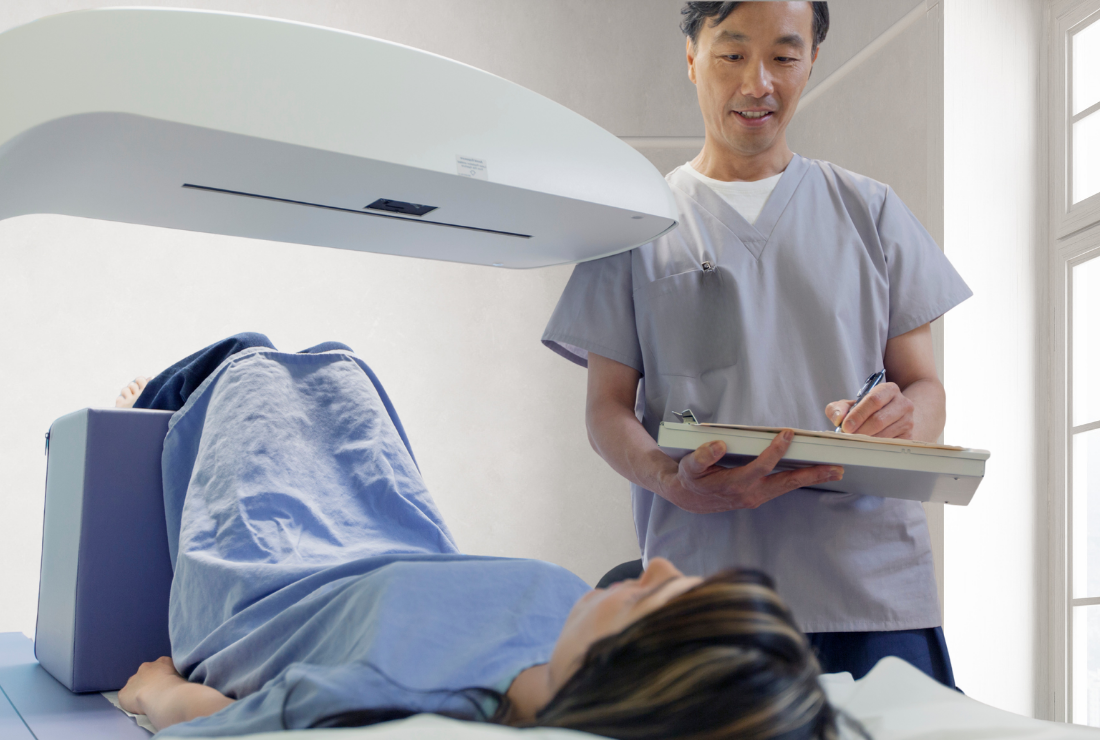
The scan usually looks at your hips and the bottom of your back. In some cases it might look at your lower arm.
As the scanning arm moves, a low dose of X-rays is passed through your body. Some of these will be absorbed by things like fat and bone. The scanning arm will detect X-rays that are not absorbed. The data it collects can be used to make a picture of the scanned area.
A DEXA scan usually takes about 10 to 20 minutes.

Questions to ask the person doing your DEXA scan
- Which parts of me are you scanning?
- When and how will I get my results?
- Who can I contact if I do not hear anything?
Understanding your results
Your medical team will compare your DEXA scan results to the results of a young, healthy adult. The difference between the two is known as the T score.
You might see this written as a number, followed by the letters SD. SD stands for standard deviation.
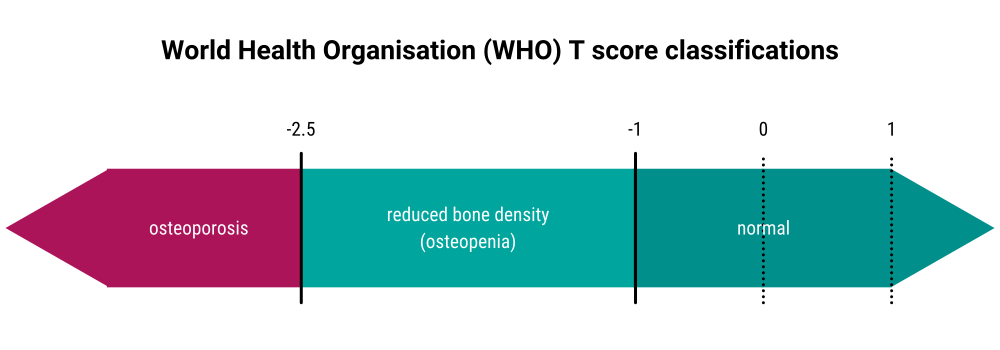
The young healthy adult would score 0 on a DEXA test. If your bones are less dense than this, your T score will be a negative number. The weaker your bones are, the bigger the negative number will be.
The World Health Organisation classifies a T score above -1 as normal. A T score between -1 and -2.5 is reduced bone mineral density, or osteopenia. And a T score below -2.5 is defined as osteoporosis.
Your scan results might also be used to calculate a FRAX index. This is a calculation that looks at lots of risk factors including:
- Your age
- If you are male or female
- If you take steroid medicines
- If you smoke
- If either of your parents suffered a hip fracture
Questions to ask the medical team about your DEXA scan results
- What is my T score and what does this mean?
- If I have reduced bone density or osteoporosis, what can I do to help my bones?
- Should I have another scan? If so, when, and how will I be contacted about it?
What happens next?
If your results are normal, but you have risk factors that put you at higher risk of osteoporosis, then you might be asked to come back for another scan in about 3 years.
If your results find that you have reduced bone density or osteoporosis you could be at a higher risk of bone fractures. This can be very worrying, but there are things you can do to reduce your risk.
Taking regular exercise and making sure you get enough calcium and vitamin D can help your bones. But it is important to talk to your liver medical team before you try any supplements. You might also be offered medicine to help your bones. This is usually tablets. But not everyone with a liver condition can have this medicine. So it is important to work with your medical team to find the best options for you.
You can find out more about osteoporosis in people with cirrhosis here.
This includes information on symptoms, treatment and living with osteoporosis. As well as links to exercises that can help your bones.
Support
How Liver UK can help
A diagnosis of liver disease can be worrying, and you may have a lot of questions.
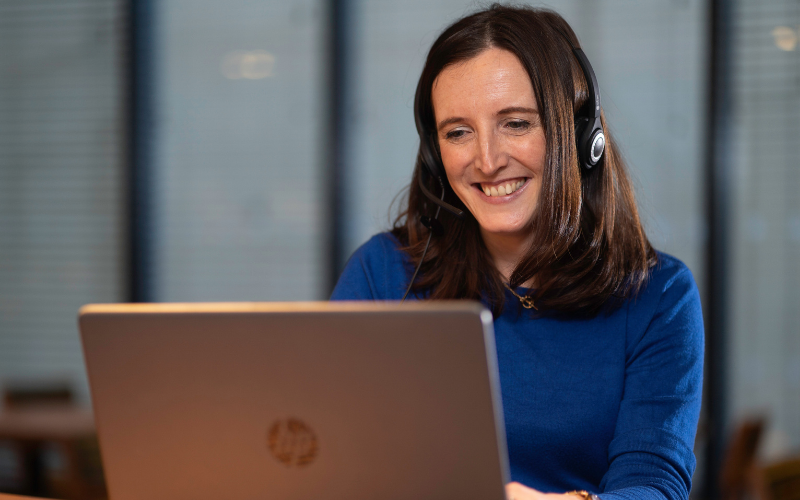
We're here for you and for your family and friends. Whether you have questions or just need someone to listen, we can help.
Your feedback
This content was last reviewed: August 2025
Our expert reviewers:
We would like to thank everyone who helped with creating and reviewing this page. Including Professor Stephen Ryder, Consultant Hepatologist at Nottingham University Hospitals NHS trust. And all our patient reviewers.
Find out how we make our patient information.
Everyone’s experience of liver disease will be different. Always talk to your specialist medical team for personal advice.
More from Liver UK

Check your risk
Find out more

Support us
Find out more
Keep up to date
Find out more