
If you have a blood test, your doctor will compare your result with a reference range. For most tests there is no reference range that applies to everyone. It is important to use the right one for you.
You might also hear this called a normal range.
Each lab uses a different range. For some tests there are also different ranges for men and women or for other characteristics.
So ranges you find online or get from other people are probably not right for your results.
If you are not sure about any of your results it is important to get personal advice from your medical team.
On this page:
How do I get the reference range for my test?
You have a right to see your full test results. You can ask your GP surgery or hospital clinic for a copy of the laboratory report. This will include the reference range used.
If you live in England or the Isle of Man you can get GP test results on the NHS app. These should show your results and the reference ranges used.
Some hospitals also allow you to see test results online or via an app.
What does my test result mean?
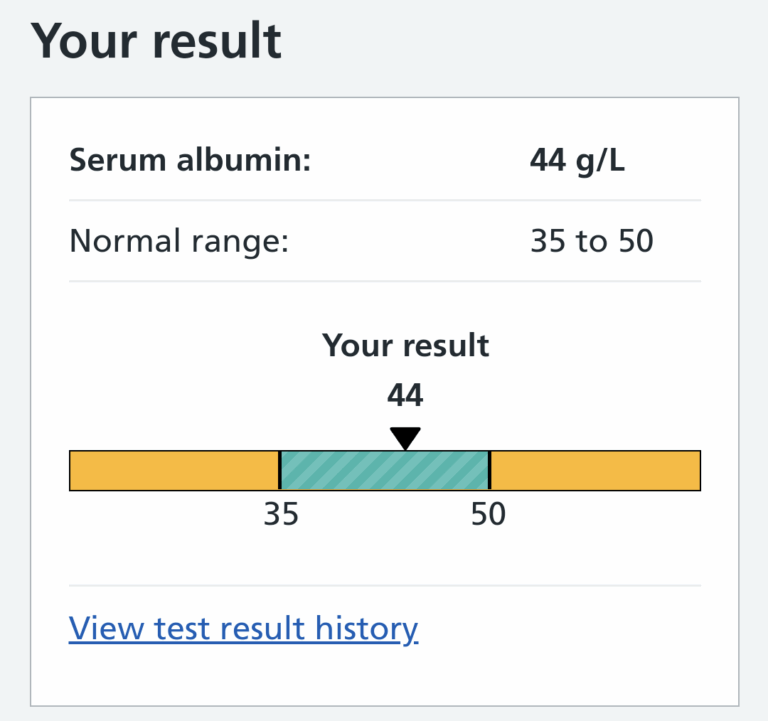
You might get your result and the reference range as numbers. Or as a diagram that looks a bit like this.
In this example, any result that was above 35 and below 50 would be in the reference range. This image is an example, you may be given a different range for this test.
You can find out more about understanding laboratory reports here.
Different labs also use different units for their results. For example, g/L (grams per litre) or IU/L (international units per litre). This is another reason why you should only use the reference range from the lab that did your test.
How is the reference range set?
Different labs use different equipment and have slightly different ways of doing each test. Because of this, each lab sets their own reference ranges.
The range is set by doing the test on a large number of people who are thought to be healthy. Because results vary a lot from person to person, the laboratory works out the range that would include 95% (19 in 20) of those tested. This is the reference range.
This means that 1 in 20 of the healthy volunteers have a result outside the reference range.
Some tests have more than one reference range. For example, there might be different reference ranges depending on:
- Age
- Ethnicity
- Pregnancy
- If you are male or female
Find out more about understanding your test results for a liver blood test.
Find out more about understanding reference ranges here.
Support
How Liver UK can help
A diagnosis of liver disease can be worrying, and you may have a lot of questions.
We're here for you and for your family and friends. Whether you have questions or just need someone to listen, we can help.

Your feedback
This content was last reviewed: July 2025
Our expert reviewers:
We would like to thank everyone who helped with creating and reviewing this page. Including Professor Stephen Ryder, Consultant Hepatologist at Nottingham University Hospitals NHS trust and Dr Laura-Jane Armstrong, Associate GP, Avonside Health Centre. And all our patient reviewers.
Find out how we make our patient information.
Everyone’s experience of liver disease will be different. Always talk to your specialist medical team for personal advice.
More from Liver UK

Check your risk
Find out more

Support us
Find out more

Keep up to date
Find out more