
What are the features of Alagille syndrome?

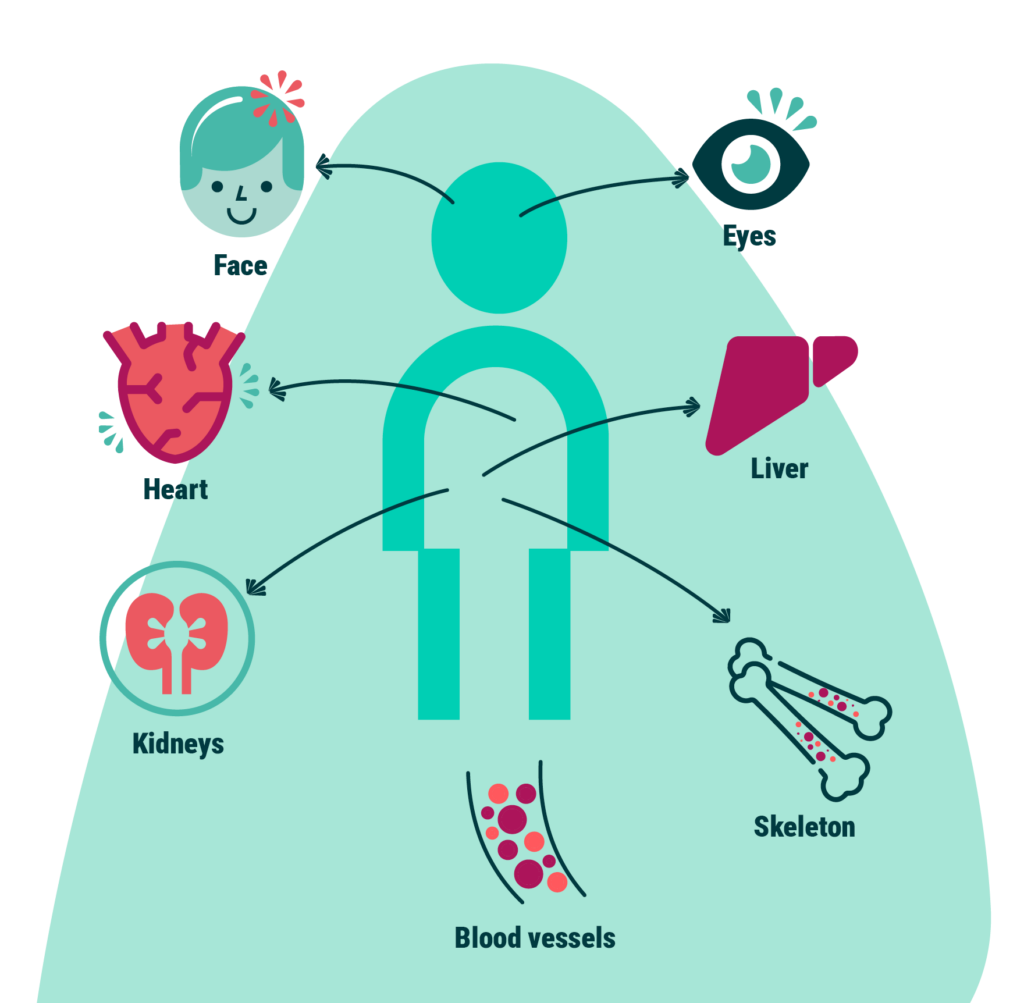
Alagille syndrome (ALGS) is a rare genetic condition. It mainly affects the liver, but can also affect other parts of the body, including the heart, kidneys, eyes, face, skeleton and blood vessels.
The information on this page is for:
- Parents of children with Alagille syndrome or suspected Alagille syndrome.
- Young people with Alagille syndrome.
- Adults with Alagille syndrome.
- Family, friends, carers, and healthcare professionals.
Alagille syndrome is different for every child. Even two members of the same family can have very different experiences of it. Some children have lots of symptoms, while others have only a few – or none at all.
On this page:
Features of Alagille syndrome
The main parts of the body that can be affected by Alagille syndrome are the liver, heart, kidneys, eyes, face, skeleton and blood vessels.
Liver problems
Liver problems are common in children with Alagille syndrome and are often the first sign of the condition. In Alagille syndrome, the liver has fewer bile ducts than normal.
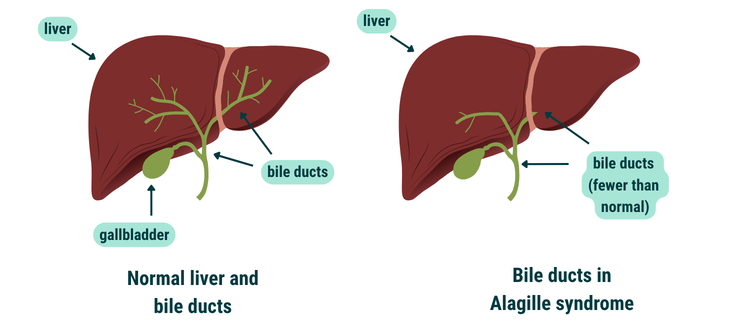
Bile ducts are tiny tubes that carry bile from the liver to the gallbladder and small intestine. When there are fewer bile ducts, bile can build up in the liver. This is called cholestasis. It usually starts in the first three months of life.
Some children have mild cholestasis and do not have major problems. In other children, cholestasis can be more severe, causing symptoms, complications and damage to the liver over time.
Not every child with Alagille syndrome will have liver problems. However, most will face liver issues at some point in their life.
In some children, liver problems get better on their own between the ages of four and ten – but this doesn’t happen for everyone. Unfortunately, doctors can’t predict which children will get better, get worse or stay the same.
Facial features
Children and adults with Alagille syndrome often share similar facial features, including:
- a high, broad forehead
- deep-set, widely spaced eyes
- a small, pointed chin
These features do not make people look unusual. They are simply common among those with Alagille syndrome. These features often become more noticeable as children get older.
Heart problems
Heart problems are common in Alagille syndrome, with most children having some type of heart issue. They range from issues that cause no harm to serious problems that affect the structure and function of the heart. In some children, heart problems can be very serious.
The most common heart problems include:
- Pulmonary artery stenosis: narrowing of the pulmonary artery, which carries blood from the heart to the lungs. Sometimes the only sign is a heart murmur (an extra sound in the heartbeat).
- Tetralogy of Fallot (TOF): a condition where four different problems affect how the heart works.
- Atrial septal defect: a small hole between the two upper chambers of the heart.
- Ventricular septal defect: a small hole between the two lower chambers of the heart.
- Coarctation of the aorta: narrowing of the aorta, the largest artery in the body.
Eye problems
Alagille syndrome can affect different parts of the eye, including the cornea, iris and retina. One common change is called posterior embryotoxon. This means there is a thicker ring around the clear, front part of the eye. It happens when the eye forms a little differently before birth.
Eye differences in Alagille syndrome usually don’t affect vision.
Bone and skeletal problems
In Alagille syndrome, the bones of the spine may look a bit different on X-rays. Sometimes they have a small notch or a “butterfly-like” shape. These changes usually don’t cause any problems.
Children with Alagille syndrome may have weaker bones, which means they can break more easily. Bone growth can also be affected. Some of these problems are due to Alagille syndrome. Others are caused by problems with nutrition and low levels of vitamin D.
Children with Alagille syndrome are often smaller in height and weight and they are likely to stay smaller as they grow.
Kidney problems
Some children with Alagille syndrome have kidney problems. Their kidneys might be smaller than normal or shaped differently. Sometimes they don’t develop properly, or they contain cysts. There can also be problems with how their kidneys work.
Blood vessel problems
Alagille syndrome can affect blood vessels in different parts of the body, including the brain, liver, lungs, heart and kidneys. When blood vessels in the brain are affected, it can cause:
- bleeding in the brain (intracranial bleeding or stroke)
- narrowing of the main blood vessel to the brain (moyamoya disease)
- bulges in blood vessels (aneurysms)
Other problems
Some children with Alagille syndrome also have:
- problems with their pancreas
- delays in reaching development milestones
- trouble with memory, concentration and problem solving
Your healthcare team
Alagille syndrome can affect many parts of the body. This means your child may see different healthcare professionals, such as:
- liver doctors (hepatologists)
- heart doctors (cardiologists)
- kidney doctors (nephrologists)
- eye doctors (ophthalmologists)
- a genetics expert (geneticist)
- specialist nurses
- radiologists
- surgeons
- dietitians
Support
How Liver UK can help
A diagnosis of liver disease can be worrying, and you may have a lot of questions.
We're here for you and for your family and friends. Whether you have questions or just need someone to listen, we can help.

Your feedback
This content was last reviewed: July 2026
Our expert reviewers:
We would like to thank everyone who helped with creating and reviewing this page. Including Professor Alistair Baker, Consultant Paediatric Hepatologist, King’s College and Lindsay Hogg, Principal Specialist Nurse, Birmingham Women’s and Children’s Hospital. And all our parent and family reviewers.
Find out how we make our patient information.
Everyone’s experience of liver disease will be different. Always talk to your specialist medical team for personal advice.

More from Liver UK

Check your risk
Find out more
Support us
Find out more
Keep up to date
Find out more