
Symptoms, tests and diagnosis for Gilbert’s syndrome
Gilbert’s syndrome is a common liver condition. Many people will have no symptoms.
The information on this page is for:
- Adults and children with Gilbert’s syndrome or suspected Gilbert’s syndrome.
- Parents of children with Gilbert’s syndrome or suspected Gilbert’s syndrome.
- Family, friends, carers, and healthcare professionals.
On this page:
What are the symptoms of Gilbert’s syndrome?
Jaundice
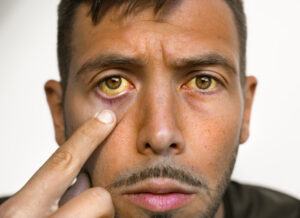
The most common symptom is jaundice that goes away after a few days without any treatment.
Jaundice is a yellow colour to the eyes or skin. In Gilbert’s syndrome jaundice is usually seen in the eyes.
Episodes of jaundice can be triggered by physical or emotional stress. You can find out more about triggers here.
Gilbert’s syndrome does not cause cirrhosis. But if someone already has cirrhosis from another condition Gilbert’s syndrome can make the jaundice worse.
Other symptoms
Some people with Gilbert’s syndrome also have symptoms caused by complications of the condition. For example itching linked to jaundice. Or digestive problems caused by gallstones.
You can find out more about gallstones here.
We have also heard from people with Gilbert’s syndrome who experience more severe problems. You can find out more here.
Tests for Gilbert’s syndrome
Talking to a doctor about Gilbert’s syndrome
Your doctor should ask you about symptoms, medical history and if anyone in the family has Gilbert’s syndrome. They should also look at the results of any liver blood tests that have been done in the past.
The doctor should do a physical examination. This will probably involve them feeling the tummy and side just below the ribs. This is to check that the liver is not larger than normal. A larger liver could suggest a different liver condition.
They will also ask for blood tests.
Liver blood test
If the doctor suspects Gilbert’s syndrome, they will ask for a test called a liver blood test. This is sometimes called a liver function test or LFT.
The liver blood test looks at several different things. One of these is the amount of bilirubin in the blood.
The amount of bilirubin can go up and down over time. So the test might be done again to see if it has changed.
If someone has Gilbert’s syndrome, all the other results from the liver blood test will be normal.
Full blood count
A full blood count is another blood test. It will probably be done at the same time as a liver blood test. It is used to rule out other possible problems.
The full blood count looks at the numbers of different types of cells in the blood. One of the things it looks at is the number of red blood cells. If there is a problem with the red blood cells and lots of them are dying this can cause an increase in bilirubin in the blood.
If someone has Gilbert’s syndrome, their red blood cells will be normal.
Other tests
If doctors are not sure about the diagnosis they might ask for other tests, usually an ultrasound scan to look at the liver.
Find out more about ultrasound scans here
A liver biopsy should not be needed to diagnose Gilbert’s syndrome. Doctors might ask for one if they think there could be a different problem with the liver.
Is a genetic test used to diagnose Gilbert's syndrome?
In most cases a genetic test is not done for Gilbert’s syndrome.
A test is available in some places to look for the most common variants. But the results do not show if someone will get symptoms and do not help with treatment. So there is usually no benefit to having the test.
In some cases a genetic test is used to confirm the diagnosis.
If I have Gilbert's syndrome, should my children be tested?
Gilbert’s syndrome can be passed down from parent to child. But not everyone with the gene variant for it will get the condition. So it can also seem to “skip” generations. There is no evidence that Gilbert’s disease causes long term harm. So there is no benefit to being tested for it unless you have symptoms.
If your child develops jaundice, or other symptoms of a liver problem you should always seek medical help. Even if they may have inherited Gilbert’s syndrome.
Diagnosing Gilbert’s syndrome
Gilbert’s syndrome is diagnosed by looking at the bilirubin level in the blood and ruling out other possible conditions. This is called a diagnosis of exclusion.
Gilbert’s syndrome will be diagnosed if all of these apply:
- a liver blood test found a higher than normal amount of bilirubin
- other test results were all normal
- there are no symptoms of other liver conditions
- there is jaundice that comes and goes
If the doctor is not certain that the condition is Gilbert’s syndrome, or if they think there might be another liver condition as well, they should make a referral to a specialist for more tests.
How we can help
Support for you
We’re here to support anyone affected by liver disease, as well as their families and loved ones.

This content was last reviewed: September 2024
Our expert reviewers:
We would like to thank all the patients and healthcare professionals who helped us to create and review this information. Including Louise Palmer, a member of our patient information volunteer group and Dr Kushala Abeysekera, Consultant Senior Lecturer in Hepatology Epidemiology and Public Health, Bristol Medical School.
Find out how we make our patient information.
Everyone’s experience of liver disease will be different. Always talk to your specialist medical team for personal advice.
Your feedback
More from Liver UK

Check your risk
Find out more

Support us
Find out more
Keep up to date
Find out more