
A guide to the 2026 BSG guidelines on identifying, testing, and referring adults with suspected liver disease.
Liver disease is very common but identifying it in the early stages is challenging. This means many patients are diagnosed at a late stage, often following emergency admission for severe complications.
Identifying patients in need of specialist care before they reach this crisis point can be crucial to treating or managing their condition.
For most suspected cases this will involve a combination of liver aetiology assessment and 2 step fibrosis testing.
Full guidelines: British Society of Gastroenterology guidelines on the investigation of suspected liver disease in adults
Who is this information for:
GPs and other primary care healthcare professionals
We also have a guide for patients, you can find this here
On this page:
Who should be tested for liver disease?
Standard liver blood tests should be offered to anyone:
- with non-specific symptoms
- fatigue, nausea, loss of appetite
- with clinical features suggestive of chronic liver disease
- ascites, spider naevi, hepatosplenomegaly
- with imaging features of chronic liver disease
- incidental findings of steatosis, cirrhosis, or portal hypertension
- taking hepatotoxic drugs
- carbamazepine, co-amoxiclav, flucloxacillin, methyldopa, minocycline, macrolide antibiotics, rifampicin, nitrofurantoin, sulfonamides, terbinafine, chlorpromazine, and methotrexate. Many other drugs can be hepatotoxic, and this can be idiosyncratic.
- with suspected or confirmed family history of genetic liver disease
- who may be at risk of viral hepatitis
- with other risk factors for liver disease
Who should be referred straight to secondary care?
- Anyone with unexplained clinical jaundice – urgent referral.
- Anyone with features of cirrhosis or portal hypertension on imaging.
- Anyone with suspected hepato-pancreato-biliary malignancy – refer for pancreatic protocol CT.
Symptoms of liver disease
Many people with liver disease have no symptoms.
Where symptoms are present in the earlier stages they may include:
- right upper quadrant pain
- fatigue
- nausea
- pruritus
In advanced stages symptoms can include:
- jaundice
- weight loss or sarcopenia
- easy bruising
- ascites
- oedema
- confusion (hepatic encephalopathy)
- GI bleeding.
Stages of liver disease
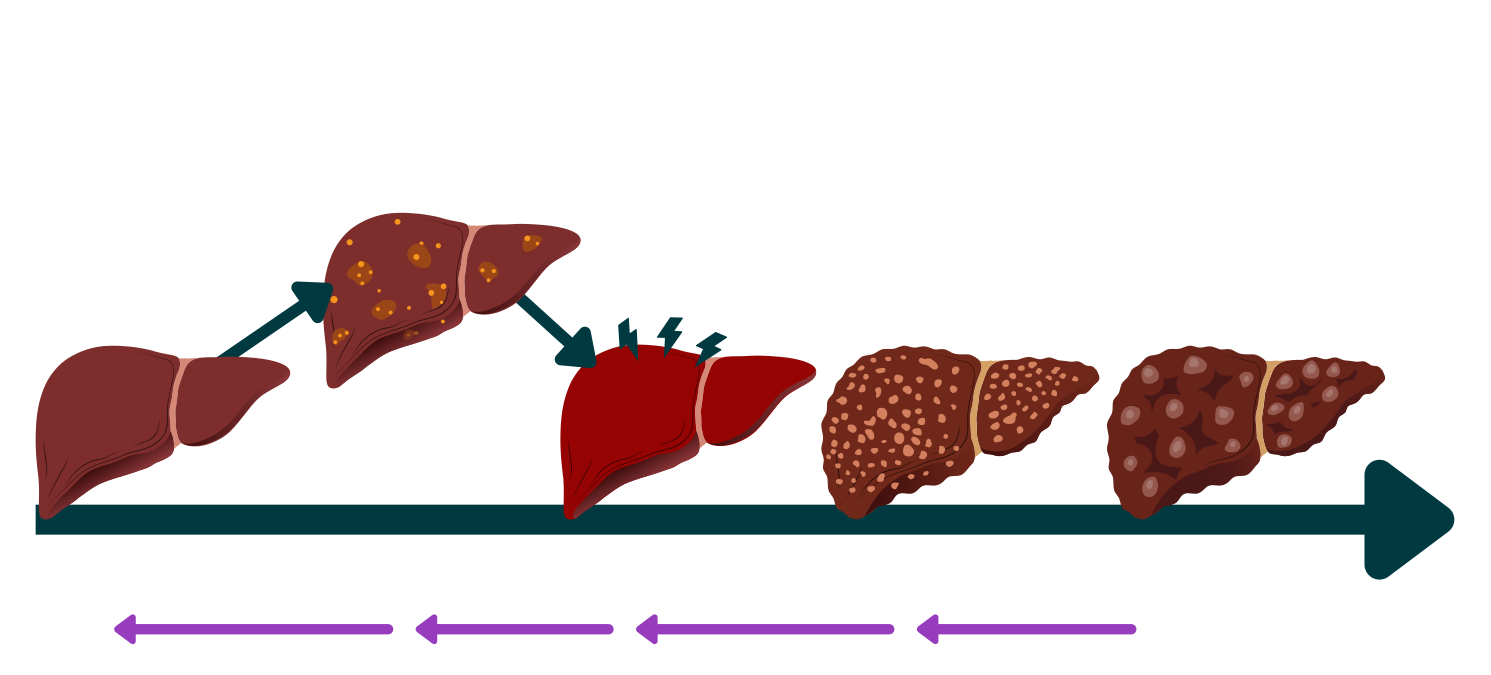
Case finding
People with the following conditions are at higher risk of developing liver disease. It is recommended that they should be identified and offered fibrosis testing.
Type 2 diabetes
People in this group should have:
- 2-stage non-invasive fibrosis testing as set out below with referral if needed.
- Repeat 2-stage fibrosis testing every 5 years if no current evidence of advanced fibrosis.
Tests for advanced chronic liver disease may not be appropriate for everyone with T2DM. Clinical judgement can be made where it may not be beneficial for the individual. For example, in people aged >75 years or with significant comorbidities.
High risk alcohol use
Alcohol is still the biggest contributing factor to liver disease in the UK.
Case finding is recommended for people drinking:
- >35 units a week for women
- >50 units a week for men
People in the above groups should be offered 2-stage non-invasive fibrosis testing as set out below.
Those attending inpatient or outpatient services for alcohol use disorder should be considered for VCTE (e.g. FibroScan) testing.
Liver blood tests
What should be included in a liver blood test?
Initial liver blood tests should include:
- bilirubin
- albumin
- ALT
- ALP
- GGT
- full blood count
Interpreting liver blood test results
Liver blood tests can’t diagnose or rule out liver disease on their own. This can only be done in combination with other tests.
Abnormal liver blood tests can signify underlying liver disease. However, it is very common for people with no liver disease to have a raised liver blood test result and also for normal results to be seen in people with cirrhosis.
Current evidence indicates that the magnitude of derangement of liver blood tests does not correlate with prognosis.
Routine repeat testing prior to further investigation is not recommended. 2024 research data found persistent abnormalities on repeat testing within 6 weeks for 78% of cases.
Any result outside the laboratory reference range should be considered abnormal.
Next steps
Anyone with abnormal liver blood tests should have further investigation, irrespective of the level and duration of abnormality.
The only exception to this is where there is a clinical suspicion of a self-limiting cause for the abnormal blood tests. For example, a transient viral illness or acute drug reaction.
Any abnormal liver blood test result should trigger 2 questions:
- What is causing the abnormality?
- What is the stage of liver fibrosis?
Clues to the cause can be found in the combination of blood test results. You can see a summary of this in the table below.
The next step is a liver aetiology screen and fibrosis assessment.
Patterns of liver blood test abnormalities and common causes
Use the drop down below to see a table of pattern of liver injury, characteristic test findings and common causes.
Patterns of liver blood test abnormalities and common causes
| Pattern of liver injury | Characteristic Findings | Common Causes |
| Hepatocellular injury (hepatitis) | ↑ ALT & AST, normal or mild ↑ ALP |
Viral hepatitis (A–E) MASLD/MASH Wilson’s disease Post heavy exercise |
| Cholestatic pattern | ↑ ALP and GGT predominantly, mild ↑ ALT/AST |
Gallstones/choledocholithiasis
Sepsis Sarcoidosis Hepatic congestion |
| Mixed hepatocellular–cholestatic | Simultaneous ↑ ALT/AST and ↑ ALP |
Drug‑induced liver injury (mixed pattern: many antibiotics, NSAIDs)
Hepatic congestion Budd-Chiari syndrome |
| Isolated bilirubin | ↑ Bilirubin (unconjugated) |
Gilbert syndrome Haemolysis |
| AST > ALT pattern | AST > ALT | Alcohol-related hepatitis Cirrhosis of any cause (AST often > ALT) Muscle disease (AST from muscle)/ Heavy exercise |
| Isolated ALP elevation | ↑ ALP but normal ALT/AST/GGT | Bone disease (Paget’s, metastases) Pregnancy Cholestasis – mild or genetic cause |
| Isolated GGT elevation | ↑ GGT alone |
Chronic excess alcohol consumption Hepatic steatosis |
ALT – Alanine Aminotransferase, AST – Aspartate Aminotransferase, ALP – Alkaline Phosphatase, MASLD – Metabolic Dysfunction–Associated Steatotic Liver Disease, MASH – Metabolic Dysfunction–Associated Steatohepatitis, GGT – Gamma‑Glutamyl Transferase, PBC – Primary Biliary Cholangitis, PSC – Primary Sclerosing Cholangitis, NSAIDs – Nonsteroidal Anti‑Inflammatory Drugs, EBV – Epstein–Barr Virus.
Liver aetiology screen
The liver aetiology screen should usually include:
- alcohol history
- medication history
- body mass index
- blood pressure
- blood tests to include:
- hepatitis B surface antigen (with reflex hepatitis D antibody when positive)
- Reflex HBV serology and HBV DNA
- hepatitis C antibody (with reflex RNA for people who are antibody positive)
- anti-mitochondrial antibody (AMA)
- anti-smooth muscle antibody (SMA)
- antinuclear antibody (ANA)
- serum immunoglobulins (IgA, IgG, IgM)
- serum ferritin and transferrin saturation
- HbA1c
- lipid profile
If ALT is severely elevated (>350iu/L or >10x ULN):
Liver aetiology screen blood tests should be different and should comprise:
- hepatitis A IgM
- hepatitis B surface antigen (with reflex hepatitis D antibody when positive)
- hepatitis C antibody (with reflex RNA for people who are antibody positive)
- hepatitis E IgM
- acute EBV serology
- CMV IgM
- anti-mitochondrial antibody (AMA)
- anti-smooth muscle antibody (SMA)
- antinuclear antibody (ANA)
- serum immunoglobulins (IgA, IgG, IgM)
Specific liver diseases such as autoimmune liver disease, viral hepatitis, or hereditary haemochromatosis carry a significant risk of progression to advanced fibrosis and cirrhosis
If the aetiology screen finds a specific cause for liver disease (other than MASLD, ALD or MetALD) the patient should be referred to specialist care according to local pathways.
Fibrosis assessment
Patients not already identified as needing referral should have 2-step sequential testing for fibrosis staging.
Stage 1: FIB-4.
It is recommend that all laboratories should be able to add reflex testing for FIB-4 without the need for additional phlebotomy. If this is not currently available, ensure AST and FBC are included in follow up blood tests to allow for FIB-4 calculation.
A FIB-4 threshold of <1.3 (<2.0 in patients older than 65 years of age) has high negative predictive value to rule out advanced fibrosis.
People with FIB-4 >1.3 (>2.0 in over 65-year-olds) should have subsequent second line testing.
Stage 2: Further non-invasive tests.
Stage 2 test choice may depend on local availability. Options include:
- Enhanced Liver Fibrosis panel (ELF; can be reflex tested in some laboratories when FIB-4 is raised)
- Liver-Stiffness by Vibration-Controlled Transient Elastography (LSM-VCTE, e.g. Fibroscan™, Echosens)
- Other forms of elastography
When used as second line fibrosis testing both ELF and elastography have been found to reduce false-positives and unnecessary referrals. They can also help predict the risk of liver related results.
The aetiology of liver disease should not influence the choice of fibrosis test or the threshold value for ALD, MetALD, MASLD, or chronic viral hepatitis.
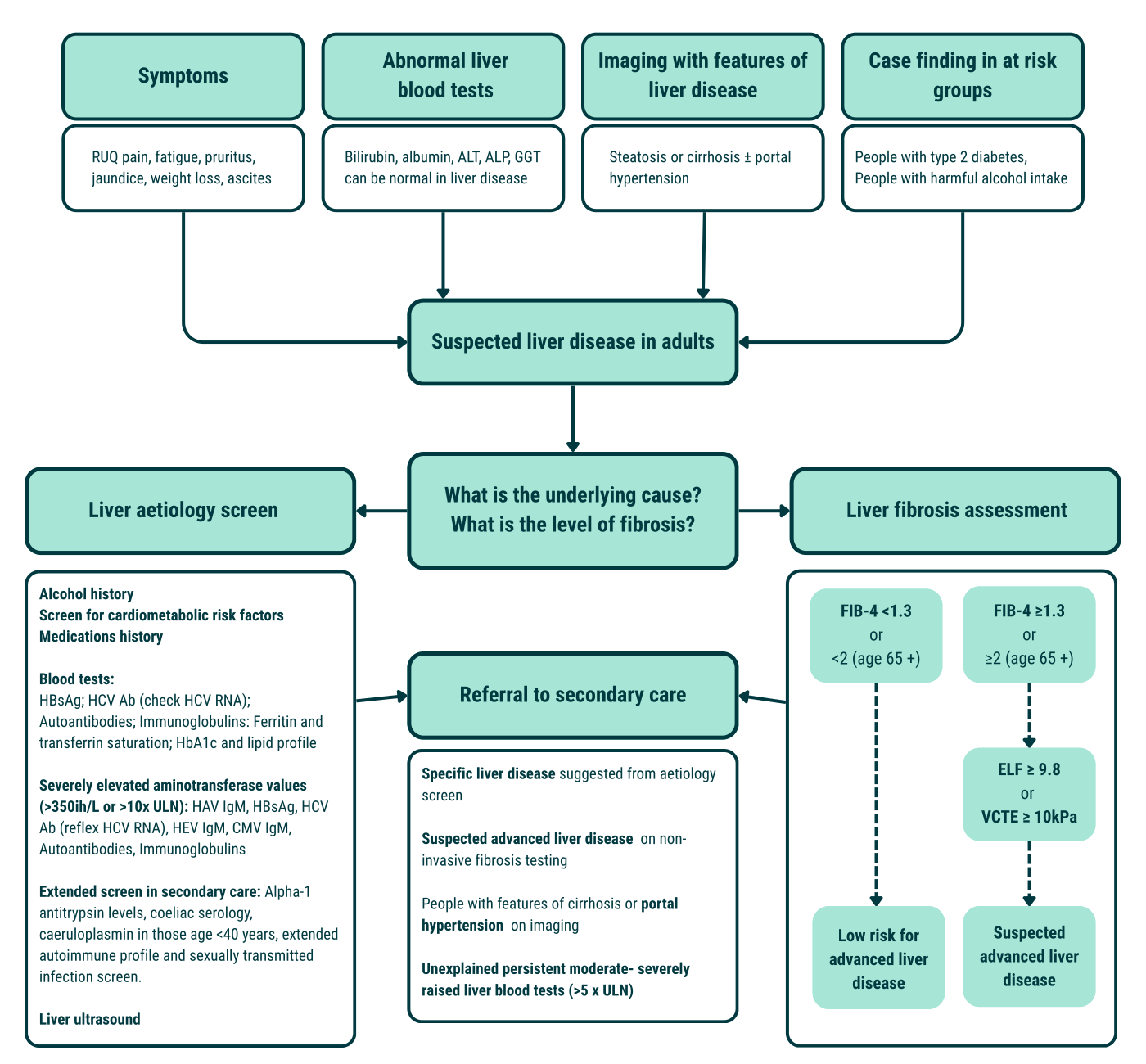
VCTE (Vibration – Controlled Transient Elastography) – (FibroScan , Echosens)
ELF – Enhanced Liver Fibrosis Panel
Who should be referred to specialist care?
The following groups should be referred.
Persistent moderate to severely raised liver blood tests
People with blood test results persistently >5 times upper limit of normal should be referred for urgent evaluation in secondary care regardless of aetiology screen results.
Fibrosis tests indicating advanced fibrosis or cirrhosis
After 2 stage fibrosis testing, referral should be made for those whose stage 2 test result was:
- Elastography: VCTE ≥10 kPa or
- ELF ≥9.8
The only exception to this would be patients who would not benefit from referral because of severe comorbidity, severe frailty or poor performance status.
Imaging features of cirrhosis or portal hypertension
People with features of cirrhosis or portal hypertension on imaging should be referred for specialist management.
Strong clinical suspicion
Overall non-invasive tests may miss 5-20% of advanced fibrosis. False negatives still occur after 2 stage testing.
If there is a strong clinical suspicion of advanced liver disease, referral to secondary care should be considered. Even if initial fibrosis tests are normal or low risk.
Special considerations - IBD
People inflammatory bowel disease and abnormal liver blood tests and should be referred for MRCP. Even if they have only mildly raised ALP or GGT.
People with cholestatic liver blood tests and suspected hepato-pancreato-biliary malignancy should be referred for pancreatic protocol CT.
Ongoing support in primary care
Supporting people who are not being referred
People with mildly raised blood test results do not need to be referred if all the following apply, they:
- are asymptomatic
- have a negative aetiology screen
- have low risk fibrosis markers
- have no identified drug or lifestyle aetiology
However, guidance may be sought from secondary care if needed.
Repeat fibrosis testing
People found to be low risk for significant fibrosis should be offered repeat fibrosis testing every 3 years if they continue to be at increased risk of liver disease. This includes people:
- who continue to have elevated liver blood test results
- with high-risk alcohol use
People with type 2 diabetes who have normal liver blood tests should be offered 2-stage fibrosis testing every 5 years up to age 75 unless they have severe comorbidity such as severe heart or respiratory failure.
Supporting patients with MASLD, ALD and MetALD
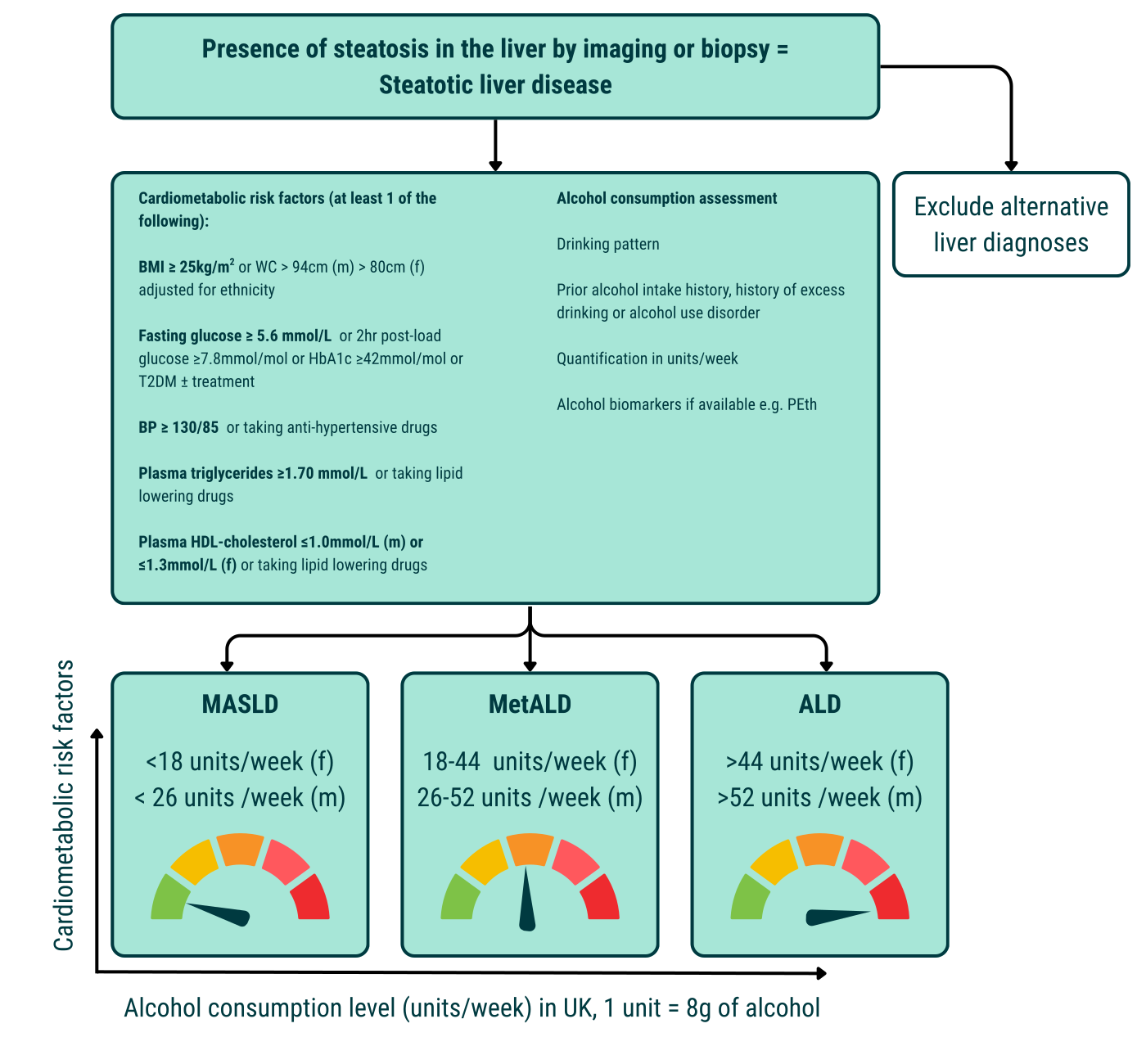
A negative liver aetiology screen in combination with an assessment of metabolic and alcohol risk factors should enable a likely diagnosis of metabolic related (MASLD) or alcohol related (ALD) liver disease to be made. A combination of risk factors may be present which suggest dual aetiology metabolic and alcohol related damage termed MetALD.
If fibrosis testing does not indicate current severe fibrosis, these patients do not need to be referred to secondary care.
Continued management in primary care to reduce risk of progression of disease is recommended
Many people with low risk MASLD or ALD could avoid disease progression to fibrosis or cirrhosis with targeted changes to their everyday lives and metabolic risk management supported by primary care
The difficulty of making and maintaining these changes is well documented. However primary care services can be a vital link to support within the practice, in the local area, or through national organisations.
LINKS to relevant current MASLD/ALD guidelines
Information and support for your patients
Liver UK provides a wide range of online information and support for anyone with a liver condition and for family and carers.
It can be automatically translated using the globe icon at the top of the page.

We offer a range of detailed printed booklets and factsheets with key information.
All our information is produced alongside patients and clinical experts. We are also members of the PIF accreditation scheme.
To find out more about ordering free publications and easy ways to signpost to our information and support services visit: Resources to share with your patients.
We also offer support groups, a nurse led helpline and a friendly online community.
More about our support services
This content was last reviewed: October 2026
Our expert reviewers:
We would like to thank everyone who helped with creating and reviewing this page. Including guideline authors, Professor Stuart McPherson, Consultant Hepatologist, The Newcastle upon Tyne Hospitals NHS foundation trust and Newcastle University and Dr Helen Jarvis, GP and Academic Clinical Lecturer, Newcastle University. Primary care reviewers, Dr Laura-Jane Armstrong, Associate GP, Avonside Health Centre, Dr Janine Plaistow, GP, Walford Mill Medical Centre, And all our patient reviewers.
Find out how we make our patient information.
More from Liver UK

Check your risk
Find out more

Support us
Find out more

Keep up to date
Find out more