
Check if you need testing, what tests to get, and when to see a specialist.
The information on this page is for:
- Any adult who may be at risk of liver disease
This information is based on the 2026 British Society of Gastroenterology (BSG) guidelines. If you’re a GP or healthcare professional, you can find more information and our guide for primary care here
On this page:
Should I have tests for liver disease?
There are lots of reasons why you might have tests for liver disease. It could be because of symptoms or risk factors. Or something could show up on another test and need looking into.
Liver disease usually develops in stages over years, starting with inflammation (hepatitis), then scarring (fibrosis). Without treatment this can lead to serious liver disease (cirrhosis).
Find out more about the stages of liver disease.
The sooner liver disease is found, the easier it is to treat or manage. So never put off getting help if you might be at risk.
If any of these things apply to you, talk to your doctor about liver disease tests:
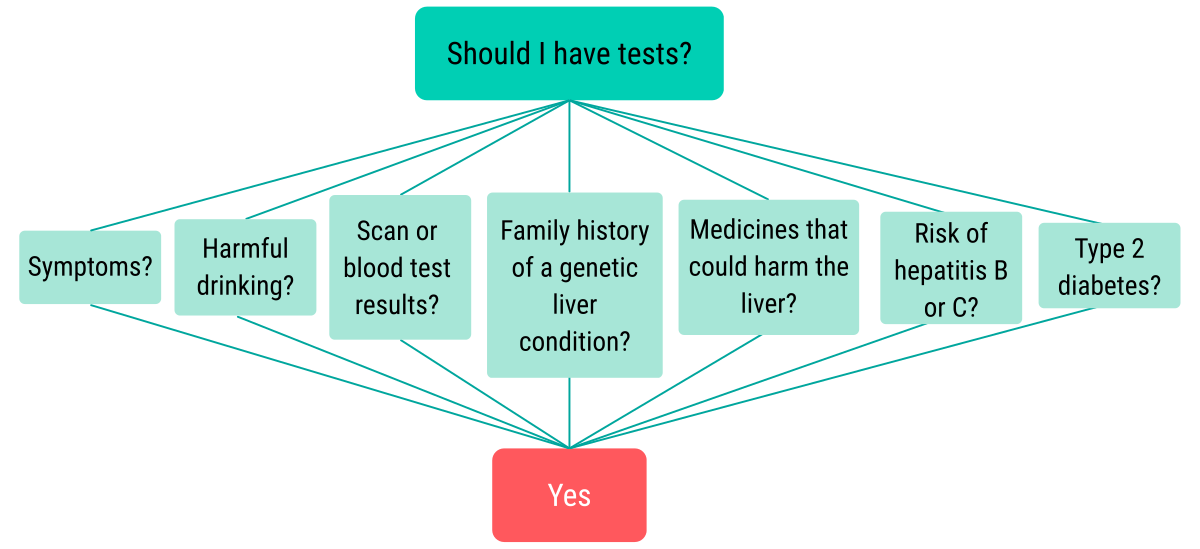
More about reasons for having tests
I’ve got symptoms that could be caused by liver disease
This includes:
Mild symptoms that could also be caused by a lot of other conditions. For example:
- feeling sick (nausea)
- feeling very tired even if you have slept well (fatigue)
- losing your appetite
More noticeable symptoms that could be caused by long term liver disease. For example:
- swelling of the tummy with fluid (ascites)
- a yellowing of the skin or eyes (jaundice)
- an enlarged liver (your doctor might feel your tummy to find this)
Find out more about the symptoms of liver disease
People with the early stages of liver disease often have no symptoms. If you are worried about your liver don’t wait for symptoms. Talk to your GP as soon as possible.
Alcohol might be harming my liver
You should be offered a test if:
- You are a man and you regularly drink more than 50 units a week
- You are a woman and you regularly drink more than 35 units a week
Find out more about alcohol, the liver, and how to work out your units.
I’ve had a scan or blood test that found a possible liver problem
Signs of a liver problem are often picked up when you have a test for something else. It does not mean you have a liver condition. But you should always have more tests if:
- a liver blood test result was not in the normal range
- a scan found a build-up of fat in your liver (steatosis), or signs of serious liver disease
I have a family history of genetic liver disease
Some liver conditions run in families. If a close family member has an inherited liver condition, talk to your GP. They can help you decide if you need a test.
I’m taking medicines that could damage my liver
Medicines can sometimes damage the liver. This includes prescription medicines, medicines from a pharmacy and also supplements and natural medicines.
We can’t predict which medicines will harm which people. But we do know that some medicines cause a problem more often than others.
The leaflet with your medicine should tell you if it is known to sometimes cause liver problems. If you are not sure about a medicine, talk to your doctor or to a pharmacist.
I might be at risk of viral hepatitis
Hepatitis B and C are caused by different viruses. But they can both cause serious long term liver damage if they are not treated.
Find out more about viral hepatitis and who could be at risk
I have type 2 diabetes
If you have type 2 diabetes you have an increased risk of liver disease. Your GP should do tests to check for scarring in your liver.
What tests should I have?
If you might have a liver problem, you doctor should try to find out:
Will my GP or hospital do the tests?
In most cases your GP will do tests to work out if you need to be referred to a hospital specialist.
You might be referred straight to the hospital if:
- You have unexplained jaundice (a yellow colour to your eyes or skin)
- You had a scan that found signs of severe liver disease (cirrhosis), or a serious problem with how blood flows through your liver (portal hypertension)
- You may have a genetic condition that needs special tests.
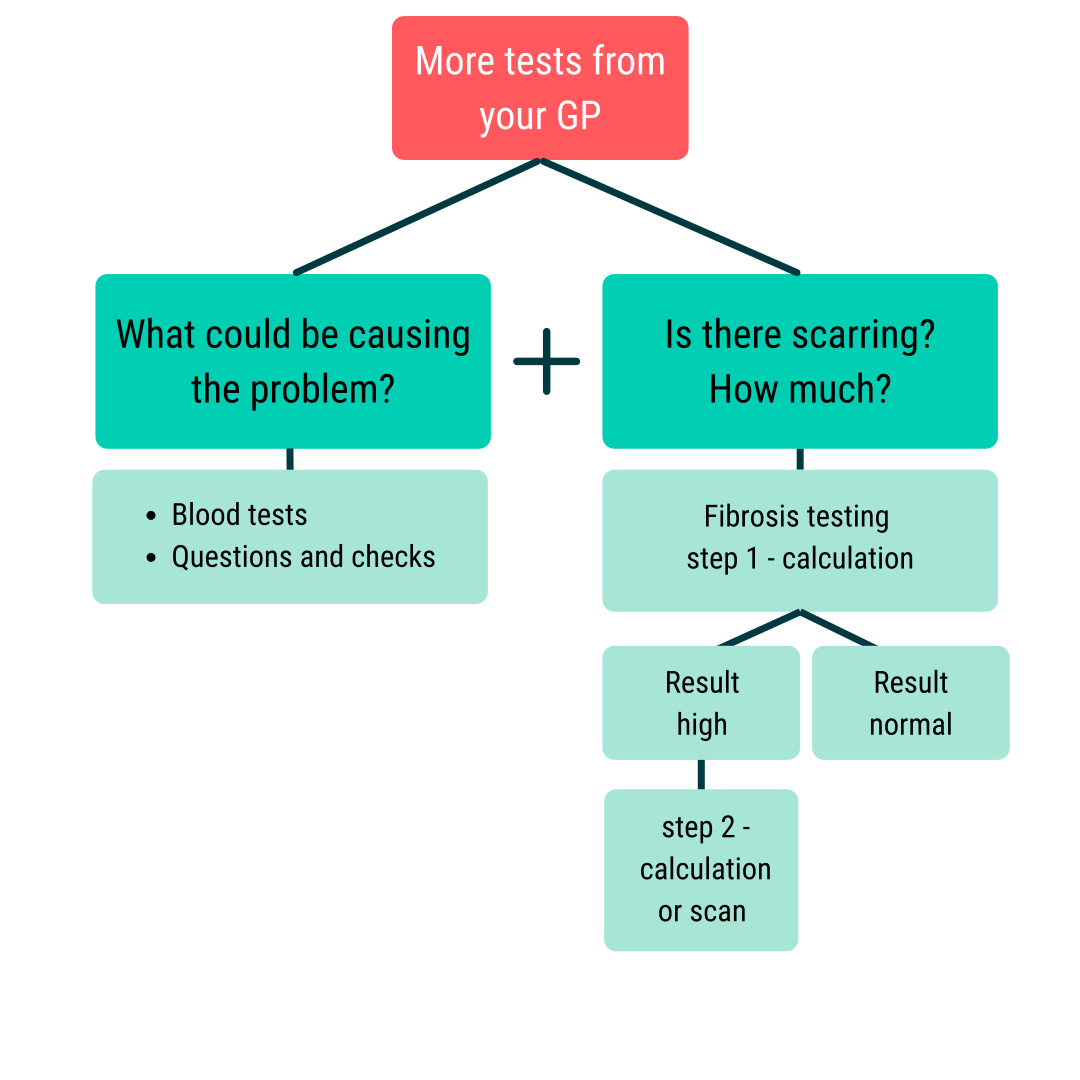
What could be causing the problem?
Blood tests
If you have not already had a liver blood test this will usually be the first step.
A liver blood test looks at a range of things including proteins and enzymes. It can give doctors an idea of how your liver is doing but it can’t be used to make a diagnosis on its own.
Your other blood tests may depend on your liver blood test results. And on what doctors suspect, or what they want to rule out.
Find out more about:
- Liver blood tests
- Full liver screen blood tests
- Blood tests for specific liver conditions
- Blood tests for conditions not in your liver
Questions and checks
Your GP should ask you questions about your:
- Weight
- they may ask to weigh and measure you.
- If you drink alcohol
- and if you do, how much and how often.
- Any other medical conditions you have, or any liver issues in your family.
- All the medicines and supplements you are taking.
Is there scarring? How much?
Scarring tests step 1 – FIB-4 testing.
A FIB-4 test is a calculation. Your doctor should be able to get a FIB-4 score using the results from liver blood tests you have already had.
- If your FIB-4 score is OVER 1.3 (or over 2.0 if you are over 65) you should have a step 2 fibrosis test.
- If your FIB-4 score is normal, you only need more tests if there are other signs of a severe liver condition.
Scarring tests step 2
Which stage 2 test you have may depend on what is available in your area. It will usually be a blood test and calculation called an ELF test. Or a type of scan. Both are very good for finding out about liver scarring. Especially when they are combined with your FIB-4 test.
ELF test
- A blood test that measures liver scarring
- If your ELF score is 9.8 or more you may be referred to a specialist for more tests.
Scan
- You might hear this called a: VCTE, Fibroscan™, Liver-Stiffness by Vibration-Controlled Transient Elastography, LSM-VCTE, or TE scan
- It is like having an ultrasound scan. It is quick and doesn’t hurt.
- To get an accurate result you should not eat or drink large amounts of fluid for at least 3 hours before your scan.
- If your result is 10kPa or more, you may be referred to a specialist for more tests.
What happens after the tests?
The tests above are sometimes enough to diagnose or rule out a liver condition. Or they might show that you need more tests from a specialist. If any of the following apply to you, you may be referred to a gastroenterology or hepatology clinic.
Gastroenterology deals with all sorts of digestive system issues. Most big hospitals have a gastroenterology department.
Hepatology is more specialised. It only looks after liver problems.
If you’re very unwell with another issue, like severe heart failure, your GP may not refer you. This is because more hospital appointments and liver tests may not help right now. You can ask your GP to explain this decision and what you need to know now.
My scarring (fibrosis) tests found I might have a problem
You may be referred if:
- Your fibrosis scan result was more 10kPa or more, or
- your ELF score was 9.8 or more
I have signs of a specific, or less common, liver disease
If you have signs of a less common liver condition, you may see a specialist for further tests. This includes conditions such as:
My liver blood test results are staying high
If you keep getting liver blood test results that are more than 5x the top of the normal range, you should be referred.
I have inflammatory bowel disease, and my liver blood tests were not normal
You may be referred for a test called an MRCP. Even if the blood test results are only a little bit out of the normal range.
An MRCP is a type of MRI scan that looks at the bile ducts.
My doctor thinks there is a problem
No test is completely perfect. A GP might refer you, or seek advice from a specialist, even if your test results are normal. For example, if you are at high risk of serious liver disease. Or if you have symptoms that strongly suggest a problem.
Where will I be referred to?
You should be referred to a gastroenterology or hepatology department at a hospital.
You may be able to choose where you are referred. You can find out more about this here.
If your GP suspects a rare or complex liver condition, they might send you to a specialist centre at a hospital further away.
What if I am not referred?
Lots of people get a liver blood test result that is slightly out of the normal range. Often this is not a problem. But you should still have the checks above to make sure.
If these tests don’t show liver scarring, liver disease signs, or serious risk factors, you won’t need a referral.
Should I have the tests again?
If you are at higher risk of liver disease, you should have scarring (fibrosis) tests again in 3 years’ time. For example, if you did not need to be referred this time but:
- you continue to have liver blood test results that are not in the normal range
- you drink a harmful amount of alcohol
If you have type 2 diabetes and your liver blood tests are normal you should have scarring (fibrosis) tests every 5 years. It is recommended to have these tests until you are 75. Unless you have another serious condition that means the tests will not be helpful for you.
If you have a calendar on your phone, make a note to remind you to get in touch with your when your next test is due.
If your tests find no concerns, then your liver is probably doing well at the moment. This is great news. But if you have any worries in the future or start to get any symptoms, always go back to your GP.
Now is a good time to find out more about looking after your liver to keep it healthy.
FAQs
What if I think I should be referred but my GP advises that it is not necessary?
This information comes from the latest guidelines by the British Society of Gastroenterology (BSG). Many GPs will be working with these guidelines, but some might not be aware of them yet.
If you think you should be referred but your GP disagrees you can ask them to look at our information for GPs here.
Ask your GP:
- What tests have I had?
- How do my results fit in with the guidelines?
- Are there any other reasons for the decision not to refer me? Can you explain these?
If you are still worried you can ask to talk to a different GP at your practice to get their opinion as well.
I’ve been told I have a build-up of fat in my liver, but not enough to be referred – what happens next?
Your doctor might diagnose a condition called MASLD. This stands for metabolic dysfunction-associated steatotic liver disease. You might also hear it called NAFLD or fatty liver disease.
If your fibrosis test results were normal, then the good news is it has been found early. Your liver could still heal itself if you can reduce the fat build up.
This usually means losing weight, eating more healthily, and being more active.
Making these changes on your own can be difficult. You can ask your GP about any local services that could help. You can also find lots more information about eating, drinking and keeping active on this website.
Download our booklet on treating MASLD with diet and exercise
I’ve been told I have alcohol related liver disease but do not need to be referred – what happens next?
Alcohol is the most common cause of severe liver problems in the UK. Alcohol does not necessarily need to be harming your life in other ways for it to be a problem for your liver.
The good news is, if your fibrosis test was normal then you have found the problem early. If you are able to stop or cut down on drinking your liver could heal itself.
We have lots more information about alcohol and liver disease. This includes ways to cut down and how to get more support if you need it.
You can also ask your GP about local services.
Cutting down on drinking, or asking for help, can be very hard. But no one choses to have liver disease. By finding out about it you have already taken a really important first step.
 Despite being diagnosed with cirrhosis thirteen years ago, I have been able to enjoy an excellent quality of life – graduating from university, working, and travelling – because I’ve been under the right medical care and been able to make informed decisions about my health. The earlier liver disease can be detected, the easier it is to take the correct measures to live well.
Support
How Liver UK can help
A diagnosis of liver disease can be worrying, and you may have a lot of questions.
We're here for you and for your family and friends. Whether you have questions or just need someone to listen, we can help.

This content was last reviewed: October 2026
Our expert reviewers:
We would like to thank everyone who helped with creating and reviewing this page. Including guideline authors Professor Stuart McPherson, Consultant Hepatologist, The Newcastle upon Tyne Hospitals NHS foundation trust and Newcastle University and Dr Helen Jarvis, GP and Academic Clinical Lecturer, Newcastle University. And all our patient reviewers.
Find out how we make our patient information.
Your feedback
More from Liver UK

Check your risk
Find out more

Support us
Find out more
Keep up to date
Find out more