
What causes Alagille syndrome?

Alagille syndrome (ALGS) is a rare genetic condition. It mainly affects the liver, but can also affect other parts of the body, including the heart, kidneys, eyes, face, skeleton and blood vessels.
The information on this page is for:
- Parents of children with Alagille syndrome or suspected Alagille syndrome.
- Young people with Alagille syndrome.
- Adults with Alagille syndrome.
- Family, friends, carers, and healthcare professionals.
On this page:
What causes Alagille syndrome?
Alagille syndrome is a genetic condition. This means it happens because of a change in a person’s genes.
Genes are like instructions in the body that tell it how to grow and work. They help make proteins, which are the building blocks for our body.
Many people have changes in their genes and most of the time these changes don’t cause any problems. But in Alagille syndrome, the change can affect the body and cause health issues.
In Alagille syndrome, more than 9 out of 10 people have a change in a gene called JAG1. A small number of people have a change in a gene called NOTCH2.
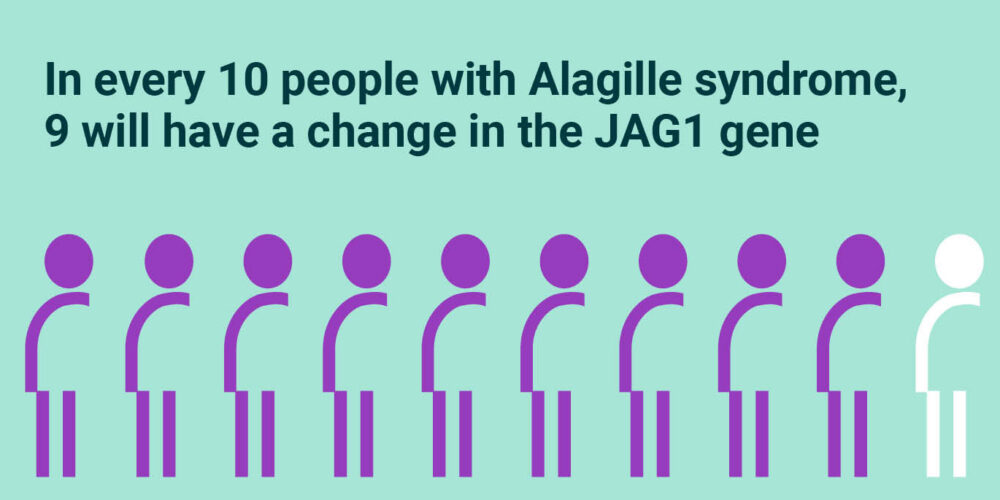
The JAG1 and NOTCH2 genes affect many parts of the body. These genes can change in different ways, which is why Alagille syndrome:
- can be mild in some children and more serious in others
- can affect many different parts of the body
Sometimes we can easily see how a gene change happens, but in Alagille syndrome it’s less clear.
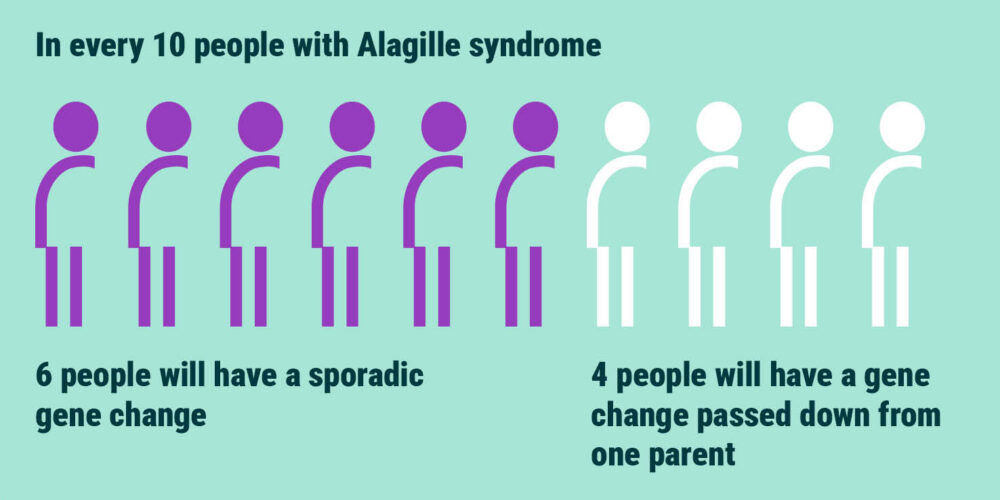
About 4 out of 10 people inherit the gene change from one parent.
About 6 out of 10 people have a change that happens randomly and is said to be “sporadic”. This means it is not inherited and happens for unknown reasons.
If a parent has Alagille syndrome, there is a 50% chance that their child will also have the condition.
Support
How Liver UK can help
A diagnosis of liver disease can be worrying, and you may have a lot of questions.
We're here for you and for your family and friends. Whether you have questions or just need someone to listen, we can help.
Your feedback
This content was last reviewed: July 2026
Our expert reviewers:
We would like to thank everyone who helped with creating and reviewing this page. Including Professor Alistair Baker, Consultant Paediatric Hepatologist, King’s College and Lindsay Hogg, Principal Specialist Nurse, Birmingham Women’s and Children’s Hospital. And all our parent and family reviewers.
Find out how we make our patient information.
Everyone’s experience of liver disease will be different. Always talk to your specialist medical team for personal advice.

More from Liver UK

Check your risk
Find out more
Support us
Find out more
Keep up to date
Find out more