
How is haemochromatosis
passed on in families?
Haemochromatosis is a genetic condition that runs in families.
All our genes come in pairs. We inherit one of each pair from our mother and one from our father.
For some genetic conditions, you only need to inherit one gene copy – these are called dominant genetic conditions.
But haemochromatosis is a recessive condition. That means that you must inherit the gene from both parents in order to be at risk of developing it.
People with one of each gene are often called carriers. They don’t have the condition, but can pass it on to their children. In the UK, around 1 in 10 people are carriers and around 1 in 160 have haemochromatosis.
Adult and juvenile haemochromatosis are caused by different gene changes. There is also a condition called neonatal haemochromatosis which is not thought to be genetic.
The information on this page is for:
- Adults with haemochromatosis or suspected haemochromatosis.
- Family, friends, carers, and healthcare professionals.
Find out about haemochromatosis in babies, children and young adults
On this page:
How haemochromatosis is passed on in families
A change in a gene that you inherit is sometimes called a gene fault, a mutation or a gene variant (because it ‘varies’ from the gene that most people have).
If you inherit one copy of a haemochromatosis gene variant, you are a carrier and can pass it on to your children. But you will never have any signs of haemochromatosis yourself. Nor will your children, unless their other parent is also a carrier. Even then, there is only a 1 in 4 chance (25%) that a child will inherit the gene variant from both parents.
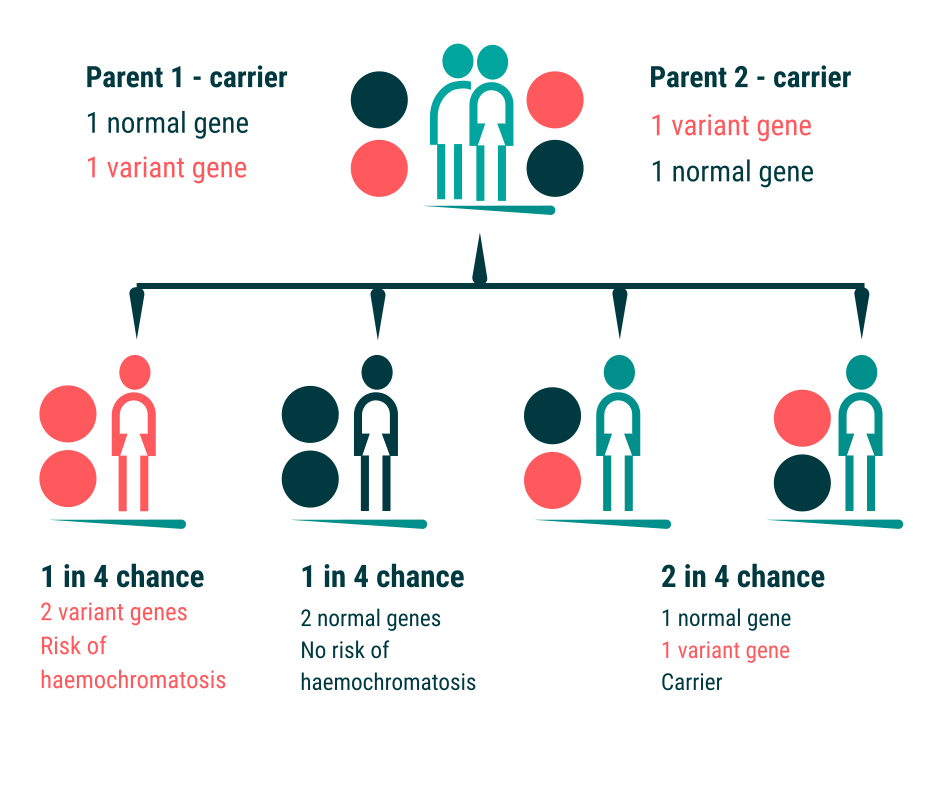
Around 1 in 10 people in the UK carry the gene variant that most commonly causes haemochromatosis. But only around 300,000 people have inherited the gene from both parents and have haemochromatosis – that’s about 1 in 156 people.
As is often the case with genetic conditions, things are slightly more complicated than that. Even if you do inherit the haemochromatosis gene variant from both parents, you may never actually develop it. This is because of something called ‘gene penetrance’.
Read more about gene penetrance
As with anyone else, your body will be affected by anything in the environment that can cause liver damage. These can make a difference to the impact of haemochromatosis on your body and include drinking alcohol and being overweight.
Types of haemochromatosis
There are several different gene variants that can cause haemochromatosis. By far the commonest is a particular change in the HFE gene. Doctors call this variant C282Y. It is the cause of haemochromatosis in more than 8 out of 10 people. This type of haemochromatosis is generally known as HFE haemochromatosis.
Haemochromatosis caused by other gene variants is generally called non-HFE haemochromatosis. A very small number of people with haemochromatosis have one HFE gene variant and one non-HFE gene variant.
In HFE and non-HFE haemochromatosis, you nearly always have to inherit a gene variant from both parents to have the condition. In very rare cases, a gene fault can happen by chance when a baby is conceived. So it’s possible that someone can develop haemochromatosis when only one of their parents has a necessary gene variant.
Haemochromatosis gene variants only usually start to have an effect in adulthood. But there are different gene variants that can cause haemochromatosis to show up in young people, between the age of 10 and 30. This is called juvenile haemochromatosis. It is caused by changes in the HAMP gene or the HJV gene. As with all other types of haemochromatosis, it is a recessive condition – you have to inherit a gene from both parents to develop it.
Remember – juvenile haemochromatosis is not the same as adult haemochromatosis. It is extremely rare and caused by changes in completely different genes.
Gene variants and risk
There are differences in the risk of developing haemochromatosis with different gene variants. C282Y carries the highest risk overall.
But some people with iron overload don’t have two copies of this particular gene variant. If this is the case for you, your doctor will need to investigate further. They can look for other gene variants that could be the cause. These may be in the HFE gene, but other genes can affect iron metabolism and they can check these too. After carrying out these tests, they will be in a better position to tell you whether treatment would be helpful for you and about your future risk of complications from iron overload.
Your doctor will also need to look at other possible causes of liver problems. These include alcohol use and a build up of fat in your liver (a condition called fatty liver.) Both of these can affect your liver blood tests, particularly your ferritin levels. If they are found to be the cause of your raised ferritin, your doctor can rule out haemochromatosis.
Whichever gene variants you have, it doesn’t necessarily mean that you will develop haemochromatosis. The risk of having iron overload with haemochromatosis genes is explained on the following page.
Support
How Liver UK can help
A diagnosis of liver disease can be worrying, and you may have a lot of questions.
We're here for you and for your family and friends. Whether you have questions or just need someone to listen, we can help.

Your feedback
This content was last reviewed: September 2025
Our expert reviewers:
We would like to thank everyone who helped with creating and reviewing this page. Including Jeremy Shearman, Consultant Hepatologist and Gastroenterologist, South Warwickshire University Foundation Trust, Sister Kim Hicks, Medical Day Unit Haemochromatosis Nurse, Royal Cornwall Hospital, Treliske, Dr Indra van Mourik, Consultant Paediatric Hepatologist (retired). And all our patient reviewers.
Liver UK thanks CSL Behring for their kind donation to support the development of this information. CSL Behring has had no influence in the initiation, development or content of this project.
Find out how we make our patient information.
Everyone’s experience of liver disease will be different. Always talk to your specialist medical team for personal advice.
More from Liver UK

Check your risk
Find out more
Support us
Find out more
Keep up to date
Find out more