
MASLD and type 2 diabetes
MASLD and type 2 diabetes are part of the same group of conditions. They are both linked to your metabolism. Your metabolism is how your body stores and uses energy.
This page explains how the two conditions are connected and how each one can affect the other.
The information on this page is for:
- Adults with MASLD or at risk of MASLD.
- Family, friends, carers, and healthcare professionals.
MASLD can also affect children and young people. See our information for parents and families.
On this page:
What is MASLD?
MASLD happens when too much fat builds up in the liver. It is a long-term (chronic) liver disease, which means it develops slowly and may get worse over time. MASLD is very common. Around 1 in 4 people in the UK have it. It is also the biggest cause of chronic liver disease worldwide.
Most people don’t have any symptoms in the early stages. Many people have MASLD for years without knowing it. Symptoms usually only appear after the liver has been damaged. There isn’t one simple test that can diagnose MASLD. It is often found during tests for other health problems.
If MASLD is found and managed early, liver damage can often be stopped or even reversed. But in some people, it can progress to a more serious stage where scarring (fibrosis) builds up in the liver. In a small number of people, it can lead to cirrhosis, liver failure or liver cancer.
The main treatments for MASLD are healthy eating, physical activity and keeping a healthy weight. These changes can reduce the amount of fat in the liver. For many people, they can also reverse MASLD.
What is type 2 diabetes?
Type 2 diabetes is a common condition where there is too much sugar (glucose) in your blood. It happens when your body doesn’t make enough of a hormone called insulin. Or when the insulin it does make doesn’t work properly. When this happens, sugar builds up in the blood. Over time, this can cause damage to different parts of the body.
Pre-diabetes means your blood sugar levels are higher than normal. But they are not high enough to be classed as type 2 diabetes.
Type 2 diabetes is very common in the UK. Over 4.1 million people have it. And around 1.3 million more people may have it without knowing. Some people with type 2 diabetes don’t notice any symptoms for years.
Type 2 diabetes is diagnosed with a simple blood test, usually done at your GP surgery. The HbA1c is the most common blood test. It shows your average blood sugar levels over the last 2 to 3 months.
If you have type 2 diabetes and your blood sugar levels stay high over time, it can lead to serious health problems. These problems can affect almost every part of your body, including your heart, eyes, feet and kidneys. The good news is that with the right care and treatment, many of these problems can be prevented.
Treatment aims to keep blood sugars within a target range. Being as active as possible, eating a healthy diet, losing weight (if needed) and going for regular health checks will help you do this. Some people also need medication, such as tablets or injections (including insulin).
The link between MASLD and type 2 diabetes
MASLD and type 2 diabetes are both conditions linked to your metabolism. Your metabolism is how your body stores and uses energy. Because of this, having one can increase your risk of developing the other.
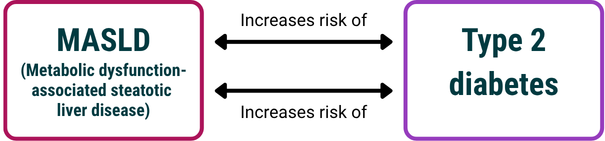
How are they connected?
If you have either MASLD or type 2 diabetes, it’s important to be aware of the link between them. Research shows that:
- Around two-thirds of people with type 2 diabetes in the UK also have MASLD
- If you have MASLD, you are more than twice as likely to develop type 2 diabetes
- For every 5% increase in liver fat, the chance of getting type 2 diabetes goes up by about 25%
Who is at risk?
MASLD and type 2 diabetes are both more common in people with:
- a weight in the overweight or obese range
- a larger waist
- a diet high in sugar and fats
- low levels of physical activity or spending a lot of time sitting down
- high blood pressure
Should I be tested?
Because MASLD and type 2 diabetes are closely linked, if you have one, it’s a good idea to be checked for the other. Your doctor may suggest this.
How do they affect my health?
Having MASLD and type 2 diabetes together increases your risk of:
- diabetes-related complications
- more serious liver disease
- heart disease
- problems with your blood vessels
What can I do?
The good news is that both conditions can often be managed in similar ways. The main treatments are:
- keeping a healthy weight or losing weight (if needed)
- eating a healthy, well-balanced diet
- being more physically active
These changes can help control both conditions and reduce the risk of complications.
Find more information in our diet and physical activity booklet
Treatments for people with MASLD and type 2 diabetes
There are currently no specific medicines available in the UK to treat MASLD. However, if you have type 2 diabetes, your doctor might give you medicines to help manage your blood sugar levels. Some of these medicines have also been shown to improve liver health. They do this by cutting down fat build-up and inflammation in the liver.
For people with severe obesity and type 2 diabetes, weight loss surgery might be an option. This type of surgery can be very effective for losing weight. This can improve both type 2 diabetes and MASLD. However, surgery is a big step and isn’t suitable for everyone.
Living with MASLD and type 2 diabetes
Living with MASLD and type 2 diabetes can feel difficult at times, but you are not alone. With the right support, you can make changes to help you stay well and lower the risk of complications.
It’s important to have regular check-ups with your GP or specialist. These visits help keep track of your blood sugar levels and liver health, so any problems can be found early. Your doctor and pharmacist can also help you with your medicines. They can make sure they are safe and work well together.
You can also get information and support from Liver UK and Diabetes UK, who are there to guide you along the way.
Support from Diabetes UK
Diabetes UK offers a wide range of information and support. You can learn about type 2 diabetes, get practical tips, and connect with others who understand your experience.
If you’d like to talk to someone, you can call their helpline on 0345 123 2399 or email [email protected].
To learn more about type 2 diabetes, visit the Diabetes UK website.
Support
How Liver UK can help
A diagnosis of liver disease can be worrying, and you may have a lot of questions.
We're here for you and for your family and friends. Whether you have questions or just need someone to listen, we can help.

Your feedback
This content was last reviewed: July 2026
Our expert reviewers:
We would like to thank everyone who helped with creating and reviewing this page. Including Dr Jeremy Cobbold, Consultant Hepatologist, Oxford University Hospitals, Professor Stuart McPherson, Consultant Hepatologist, Newcastle upon Tyne Hospitals and Dr Helen Jarvis, GP, Newcastle University. And all our patient reviewers.
Find out how we make our patient information.
Everyone’s experience of liver disease will be different. Always talk to your specialist medical team for personal advice.

More from Liver UK

Check your risk
Find out more

Support us
Find out more
Keep up to date
Find out more