
What are the stages of MASLD?
MASLD is a common condition where fat builds up in the liver. It is often linked to being overweight and conditions like type 2 diabetes and heart disease.
The information on this page is for:
- Adults with MASLD or at risk of MASLD.
- Family, friends, carers, and healthcare professionals.
MASLD can also affect children and young people. See our information for parents and families.
MASLD has several different stages. Doctors check for liver scarring (fibrosis) to work out the stage of the disease.
Having one stage does not mean you will always move to the next one. It is possible to slow or even reverse the damage, especially if it is at an early stage.
Most people will be at fibrosis stage 0. This means there is fat in the liver but no inflammation or scarring (fibrosis). But if MASLD is not found and managed, it can progress to more advanced stages over time. See the table below to understand the different stages of MASLD.
On this page:
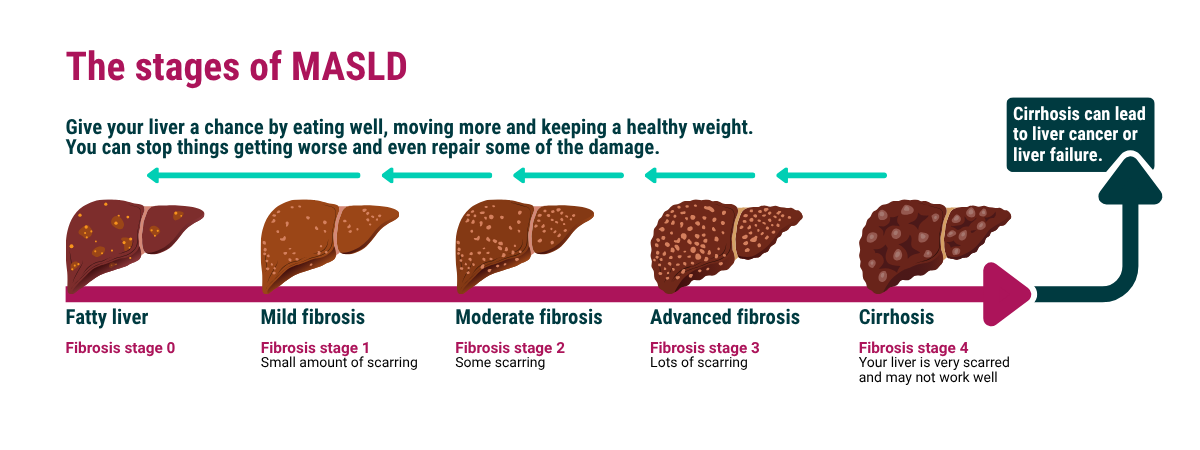
MASLD stages
| Stage | Description |
|
Fibrosis stage 0: Fatty liver You may also hear this stage called:
|
There is extra fat in your liver, but no inflammation or scarring. Your liver is working normally, and this stage can be fully reversed. You will probably have no symptoms. |
|
Fibrosis stage 1: MASLD with mild fibrosis |
The build-up of fat causes inflammation (irritation and swelling) in the liver. Over time this has caused a small amount of scarring. Changes to your everyday life can help reduce fat and reverse inflammation. |
|
Fibrosis stage 2: MASLD with moderate fibrosis |
The build-up of fat has caused inflammation (irritation and swelling) and some scarring. Your liver is probably still working well and most of the damage can be repaired. |
|
Fibrosis stage 3: MASLD with advanced fibrosis |
Inflammation is causing more scarring, but your liver should still be working well. Most of the damage can be repaired. It is important to take steps to stop any further damage. More scarring could lead to cirrhosis and liver failure. |
|
Fibrosis stage 4: Cirrhosis |
Large parts of the liver have become damaged and scarred. It is usually the result of long-term liver damage. Your liver may keep working and can even repair some damage at this point. But if there is too much scarring, your liver may not be able to carry out its job properly. Cirrhosis can lead to life-threatening conditions including liver failure and liver cancer. |
Doctors cannot predict whose MASLD will get worse (progress) over time. But research tells us that out of every 100 people with early-stage MASLD:
- 10 – 30 develop advanced scarring (fibrosis) and more serious liver disease
- 70 – 90 do not develop advanced scarring (fibrosis) and more serious liver disease
The risk of progressing to more serious liver disease is higher in people with obesity or type 2 diabetes.
Doctors also don’t know how fast MASLD will progress for each person. For most people, it takes many years or even decades. But in some people, it can happen more quickly. The good news is that the liver is an amazing organ that can repair itself. If MASLD is managed early, liver damage can be slowed or even reversed over time.
No matter how advanced your liver disease is, the greatest risk to overall health is often heart attack and stroke. That’s why improving and protecting heart health is usually a key first step in treatment.
No matter how advanced your liver disease is, the greatest risk to overall health is often heart attack and stroke.
That’s why improving and protecting heart health is usually a key first step in treatment.
Support
How Liver UK can help
A diagnosis of liver disease can be worrying, and you may have a lot of questions.
We're here for you and for your family and friends. Whether you have questions or just need someone to listen, we can help.

Your feedback
This content was last reviewed: July 2026
Our expert reviewers:
We would like to thank everyone who helped with creating and reviewing this page. Including Dr Jeremy Cobbold, Consultant Hepatologist, Oxford University Hospitals, Professor Stuart McPherson, Consultant Hepatologist, Newcastle upon Tyne Hospitals and Dr Helen Jarvis, GP, Newcastle University. And all our patient reviewers.
Find out how we make our patient information.
Everyone’s experience of liver disease will be different. Always talk to your specialist medical team for personal advice.

More from Liver UK

Check your risk
Find out more
Support us
Find out more
Keep up to date
Find out more